
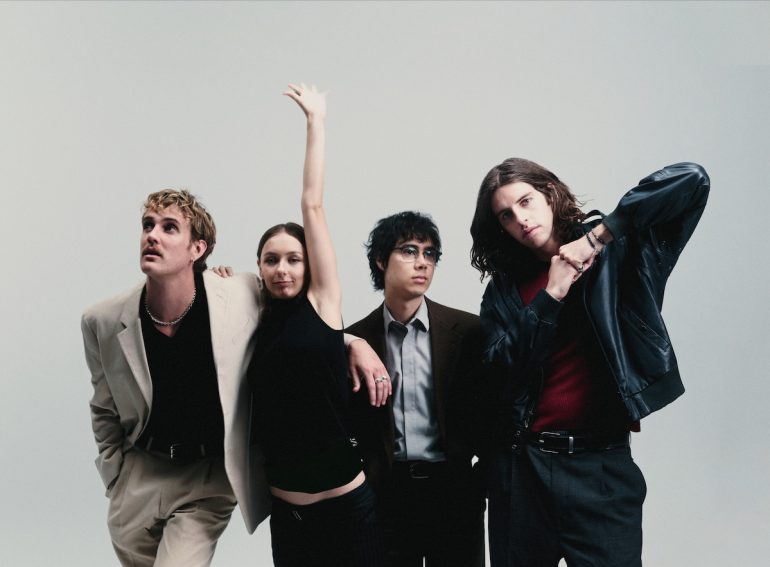
After performing on stages across North America, the Australian indie-rock band Spacey Jane has dominated what they refer to as “their international debut.” With only a week left until their London show at O2 Academy Brixton, Noctis catches up with Caleb Harper, the lead vocalist and guitarist. Three years and one new studio album later, Harper dives deep into the makings of their third record, ‘If That Makes Sense.’
Sitting in the green room in First Avenue, a concert venue in Minneapolis, Minnesota, Caleb Harper reflects on the two-week-long run. “It’s the first day of rain of the tour,” he says, “I guess it’s always nice for a change. It’s getting to this point in the tour where you don’t really go outside that much anymore.” He right away mentions a travel day, when the whole band went to Indiana Dunes State Park, and went swimming in Lake Michigan, “we’ve done some good stuff, I think, because we’ve been touring pretty healthily, we haven’t been partying really, and because of that, we have time to do fun stuff and explore places.”
“There is a rhythm,” Harper talks us through their day-to-day tour life regime, “if it’s a sunny day and everything’s great, let’s go for a walk. If it’s rainy like it is today, I’ll probably catch up on emails. I’ve got work stuff at home to look after.” Besides the constant activity of packing up, unloading, and soundcheck, Spacey Jane fans can enjoy a new VIP package for the first time, for which Caleb and Ashton, the lead guitarist, prepare every night.
We’re increasingly seeing the trend of a VIP fan experience in live entertainment. The relationship between an artist and a fan can only strengthen in moments when you’ve been given a chance to interact and be closer to your favorite performer. Though for musicians, who are used to interacting with people on a bigger scale, it may present a nerve-wrecking setting: “Honestly, we were a bit daunted by it, like this is a bit weird for us, but it turns out that’s very common, and we just had to get over our preconceived ideas of it,” Harper admits, “We’ve been playing a few songs acoustically, Ashton, Peppa, and I. There were a couple of days when my voice was a bit funny, so we actually played some unreleased music,” my eyes open wide with a spark and hope of new Spacey Jane material.
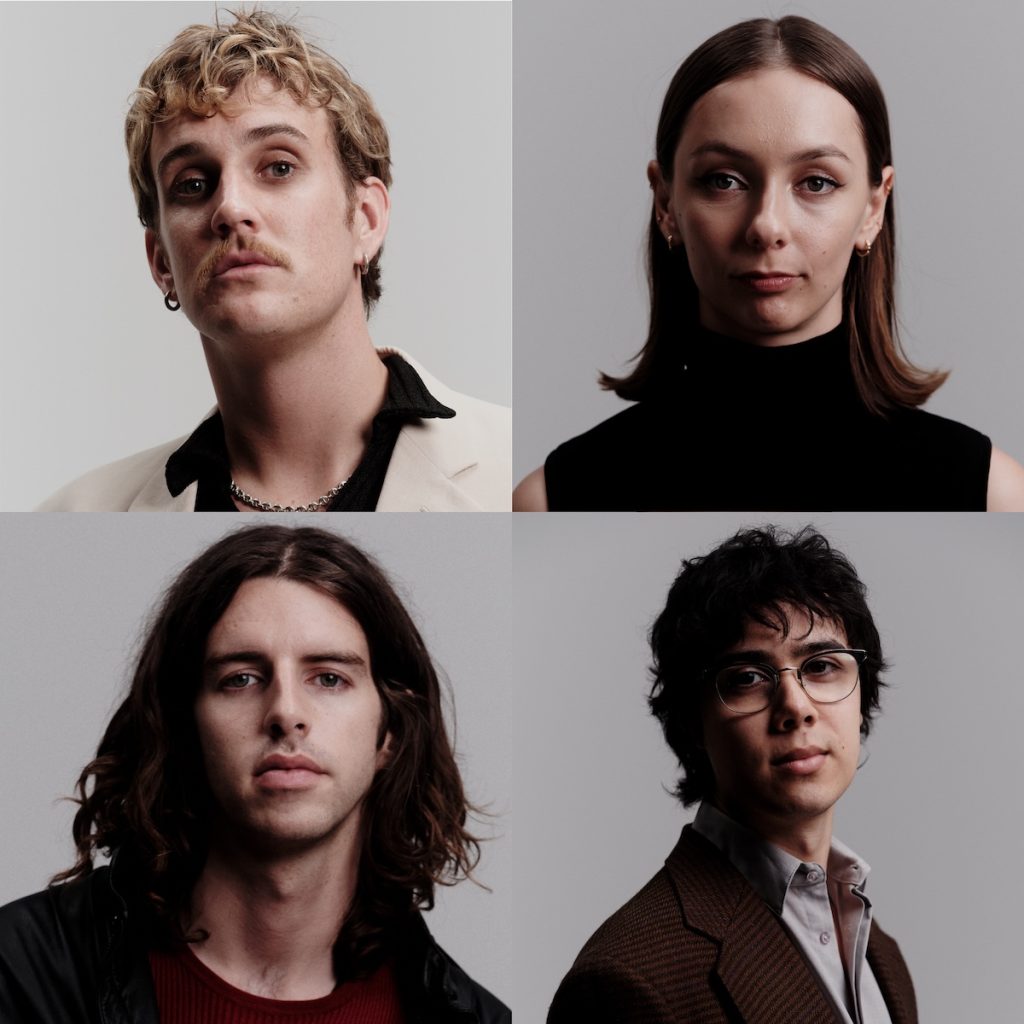
With a proud smirk, Harper nods and spills the tea of a new project and the tension of sharing it in a close circle: “We have an EP next year, hopefully sometime in March. We just played a bunch of songs that we hadn’t put out yet, which was pretty funny because it’s hard enough sharing new music with people, let alone to 20 or 30 fans, who are right in front of you. I’m trying to figure out, looking at their faces, if they like it. It’s like controlled testing your music.”
To avoid asking too many questions about the upcoming EP, I bring up the star of the show, Spacey Jane’s third studio album, ‘If That Makes Sense.’ Two weeks after the release of the record, the band performed at triple J’s One Night Stand, a free music festival in regional Australian towns. Harper said he felt nervous performing the new discography. Going from city to city in the US, Harper compares the audiences and the time, ‘If That Makes Sense’ had to resonate with the fans: “We probably played around 40 shows for this album cycle now, and it definitely feels pretty natural. What’s been really interesting about the US versus Australia is that the album has been out for a few more months. The sing-alongs to the new songs are even louder. The album really connected here. There’s a lot of new fans at the shows, who discovered us through this record.”
Due to the pandemic and its impact on touring and the music industry, this can be considered “an international debut” for Spacey Jane. Right before the pandemic hit, Caleb, Ashton, Kieran, and Peppa quit their jobs to focus on music. Despite the limitations of border closures and isolation periods, Spacey Jane’s debut album, ‘Sunlight,’ became Australia’s pandemic anthem.
Being able to tour all over the world in the current day, Harper reflects on the situation and what it meant for the band: “It was the worst timing, and obviously, many people had far worse experiences. All of us were really fortunate not to lose loved ones. A lot of people had some really horrible COVID experiences. Ours is more like, oh, we can’t do music. But it still felt like our world was crumbling a little bit. But also Australia, they just shut the borders down. And then, state by state, they shut borders down. So in Western Australia, where we were, for the first year and a half, there were no COVID cases. So we were touring in Western Australia, you could play venues, but you couldn’t leave the state and get back in.”
He adds, “but the album for us came out in this vacuum of releases; no one was putting music out. It’s our first record. There’s no expectation. It’s not like we have this fucking million-dollar marketing plan that’s going to fall apart. We’re trying for the first time. And that actually worked in our favor. It felt like in Australia, it was a bit of a pandemic anthem for people, and it was this thing that people held onto. In a way, I don’t think it was the worst thing for us as a band. It was a stutter start, but we got there eventually”.
After the success of both the debut, ‘Sunlight,’ and the sophomore album, ‘Here Comes Everybody,’ ‘If That Makes Sense’ was a result of other moving parts, which ultimately pushed the band outside of their comfort zone and into a place where they made their best record yet. First up, it was the management’s request to pause touring, Harper explains: “In 2022, just before ‘Here Comes Everybody’ came out, we signed management, our drummer Kieran had been our sole manager until that point, and he’s still in the management team, but now we have a company looking after us, which is good because they have the resources and people. They are LA-based and have a really great history of working with bands on long-term projects, which is cool. Their message to us was, ‘stop touring for a second, please, and just make some music and just pause.'”
As Spacey Jane saw their come-up in the club scene in Perth, live shows were crucial for their career; it was all they knew, according to Harper: “We were a band that thrives on playing live. You didn’t get signed quickly you didn’t have management quickly. You just play shows. And so for us to be off the road and at home and writing is weird.” As soon as he got into the rhythm of writing, he found it satisfying. “I moved to LA, and then the band followed me eventually for recording, and it felt like, this is the year and a half to write and make the best record we can, and that’s the focus. We’re going to invest heavily in time and money and really get this record right first and then think about when we’re going to tour it and how we’re going to market it.”
It is to be expected to feel lonely when moving across the world, but you can’t necessarily prepare for it. Even though every room was full of fascinating people and always someone to network with, Harper had no touchstones of comfort in the beginning. He answers whether the initial isolation inspired the album or put him into a spiral: “It was overthinking first, and I think eventually things clicked. I’ve said it in many interviews, but I didn’t have my friends, and it was pretty lonely, just there with my thoughts, and I think that made a good album. I didn’t have any distractions. I was like, I’m here to make a record.”
For the writing and recording process, Caleb Harper and the rest of the band collaborated with producer Mike Crossey (The 1975, Arctic Monkeys, Wolf Alice), and songwriters Jackson “Day Wave” Phillips and Sarah Aarons (Childish Gambino, Miley Cyrus, Lykke Li). Harper shares how each of them shaped the album into a cohesive body of work with a new dimension of vulnerability: “Sarah wanted me to be more lyrically specific. It was a good challenge for me. Because I thought harder about lyrics, which I think actually made the record more intimate and personal than it would’ve been otherwise, which is almost counterintuitive because you might think that the more hands you have on something, the less personal, more prompt. But it felt the other way around.”
He continues: “Working with Jackson on ‘Through My Teeth’ and ‘So Much Taller’, I had this freedom because I wasn’t holding a guitar or I wasn’t on the computer, I would just throw up weird melodies. And that’s why I think ‘So Much Taller’ has such a crazy high full set of vocal parts, something that I wouldn’t necessarily write normally. Also, the differences in perspective and process that bring something out of you. Mike is the most fastidious guy I know. It’s all very considered. We also spent 12 weeks in the studio, the longest we’ve ever spent, which is longer than most bands ever do. It’s quite rare. So the record was more cohesive because we could be more preferential. The album took on a life of its own before we even finished it, which was cool.”
Besides the new collaborators, all band members were in different parts of the world. Still, as much as it introduced new pressures and challenges, Harper reveals, they were forced to communicate better than they had before: “It was a logistical nightmare. It wasn’t easy at all, and it was expensive, but we learned a lot from it, and I learned a lot about collaboration throughout the process. Having gone from being very closed off in the writing process and doing everything on my own in my room, to let’s open things up a bit and learn how to bring in new voices and ideas in a way that elevates our vision.”
As someone who’s been through the emotional tyranny of a long-distance relationship, I found lyrical reminiscences throughout ‘If That Makes Sense.’ As it is not the most common topic for commercial music, Harper and I began contemplating whether long-distance is worth it and when. Dissecting the subject, he concludes: “That’s my one thing. The greatest gift of writing music is that I realized everyone’s been through something, and people will always find something in your music to relate to. So if you’re honest and as clear as you can be about what you’re going through, people will get it.”
Finding out more about the making of ‘If That Makes Sense,’ it seems there were more obstacles than none. Still, Harper confirms recording outside of their comfort zone, like a different country, will be the way forward for future Spacey Jane albums: “I think it’s the only way we’ll do it from now on. I think it’s the challenge of it and what it brings out of us. We do our best work when the fire is underneath us. We’ve learned now that’s the way for us to make an album. We’ll try to never be comfortable again when we’re making music.”
As a fan, I would second that. ‘If That Makes Sense’ awakens an instant sensation of musical bliss, and from start to finish, a collection of earworms. Whatever ingredients Spacey Jane whipped up together, they accumulated them into a mature, cohesive album, which definitely marks a celebratory chapter for the band. London fans, get ready, Spacey Jane graduated from the Roundhouse all the way to O2 Academy Brixton, “it’s going to be our biggest show ever outside of Australia,” Caleb Harper announces.
Follow Spacey Jane On Instagram
Words: Karolina Kramplova
Photographer: Cole Barash