
Nestled between the bustle of fashion students gossiping, sketching, and typing, I sit across from Mia Wanaka Brimilcombe. She’s wearing an off-the-shoulder striped top, a chunky necklace with clear crystals and a shell dangling from the centre, and little gold stars on the outside corners of her eyes, and I note that her look is distinctly different from her designs. “I didn’t really think about fashion until I was in secondary school, and even then, it was never about what I was wearing,” she tells me, very matter-of-factly, “It was always that I loved making and styling and taking photos of my sister. It was never about my own identity. I think it was always about a separate thing.”
This fashion-oriented mindset has still never really materialised for her, despite rapidly approaching the end of her BA Womenswear Design degree at Central Saint Martins. “It’s not really about going to a fabric shop and buying fabric. It’s more like, ‘Oh, there was this thing lying around and visually, that made me want to make this with it’,” she reflects.
Starting her university career with a foundation course specialising in fine art at Brighton Metropolitan College, Brimilcombe quickly discovered that what she loved about art was “the whole experience of living people,” and that’s where fashion came into play. She’d seen the work that had come out of Central Saint Martins in college and immediately knew that’s what she wanted to do. From there, several internships at the likes of Charlie Allen Bespoke Tailors and ERDEM during her placement year helped expand her skillset and grow her confidence. Still, when she speaks of her work, she has that self-deprecating nature so common among art students – almost like she doubts herself. The longer I spend with her, though, the more I realise it’s not insecurity – and I get the sense that she thrives in organised chaos. Her humility is simply a way of embracing the mess.
She’s a maverick, letting her process guide her and steering away from conforming to any kind of expectations. But, it’s less so an act of rebellion. It’s something that has always run through her veins. “A lot of [my work] is directed by the materials themselves, the way some artists might like to work on a painting, in the sense of seeing what happens and it gets better or changes along the way. You don’t necessarily have this definite idea of how it’s going to turn out.”
Brimilcombe’s creative process is a testament to the way she grew up: experimenting with, deconstructing, and reusing anything she could get her hands on to make whatever outlandish idea her brain could think up. Growing up in a small cottage in Firle, a village in East Sussex, she spent most of her time outside the turquoise and bubblegum pink walls of her childhood home and in the garden, climbing trees and making contraptions from old bin lids and pipes. “When [my twin sister and I] were nine, my mum bought us an old Singer sewing machine,” she reminisces, smiling to herself, “It meant suddenly being able to make loads of different things.”
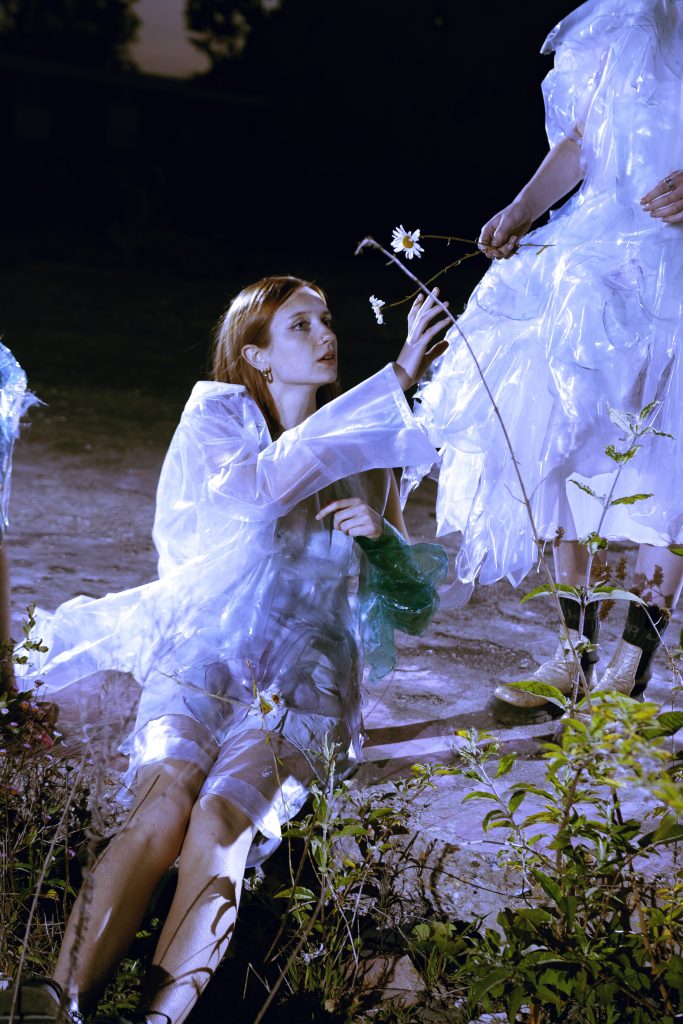
It’s those moments that have inspired her graduate collection, specifically, “the visuals and memories of growing up in (at times) quite a complicated childhood – I mean, everyone has that I guess – but with these very beautiful romantic settings and surrounded by art and people who are artists and actors,” she shares. She found herself referencing her mum’s cottage and the gardens surrounding it, including china mugs hanging under shelves, a teal chandelier, and chilli pepper string lights hung in the kitchen alongside the countryside landscape. “Since we were little, she’s had a slightly bizarre belief in materials doing what they aren’t meant to do – for example a zip-wire out of yarn and a swing out of a bin lid. Her imagination and excitement to use whatever materials come to hand has followed her into adulthood and her designs,” her sister Ava notes.
Beyond that, Brimilcombe is exploring the physicality of memories – or rather lack thereof. “For something to be important to you, you don’t need to cling on to it, to hold on to it like an object. Memories are some of the most important things to people,” she says, deep in thought, “I’m trying to show fashion as art, as an experience and a memory.” For that reason, she’s been toying with the idea of burying her collection post-show. Because the collection has been constructed almost fully from bioplastics that she made from scratch (and other biodegradable materials), it’s completely compostable and would break down in the soil. She tells me excitedly of the plans she has to make that a reality, “I want to go on a road trip somewhere, bury it, and make a documentary or something.”
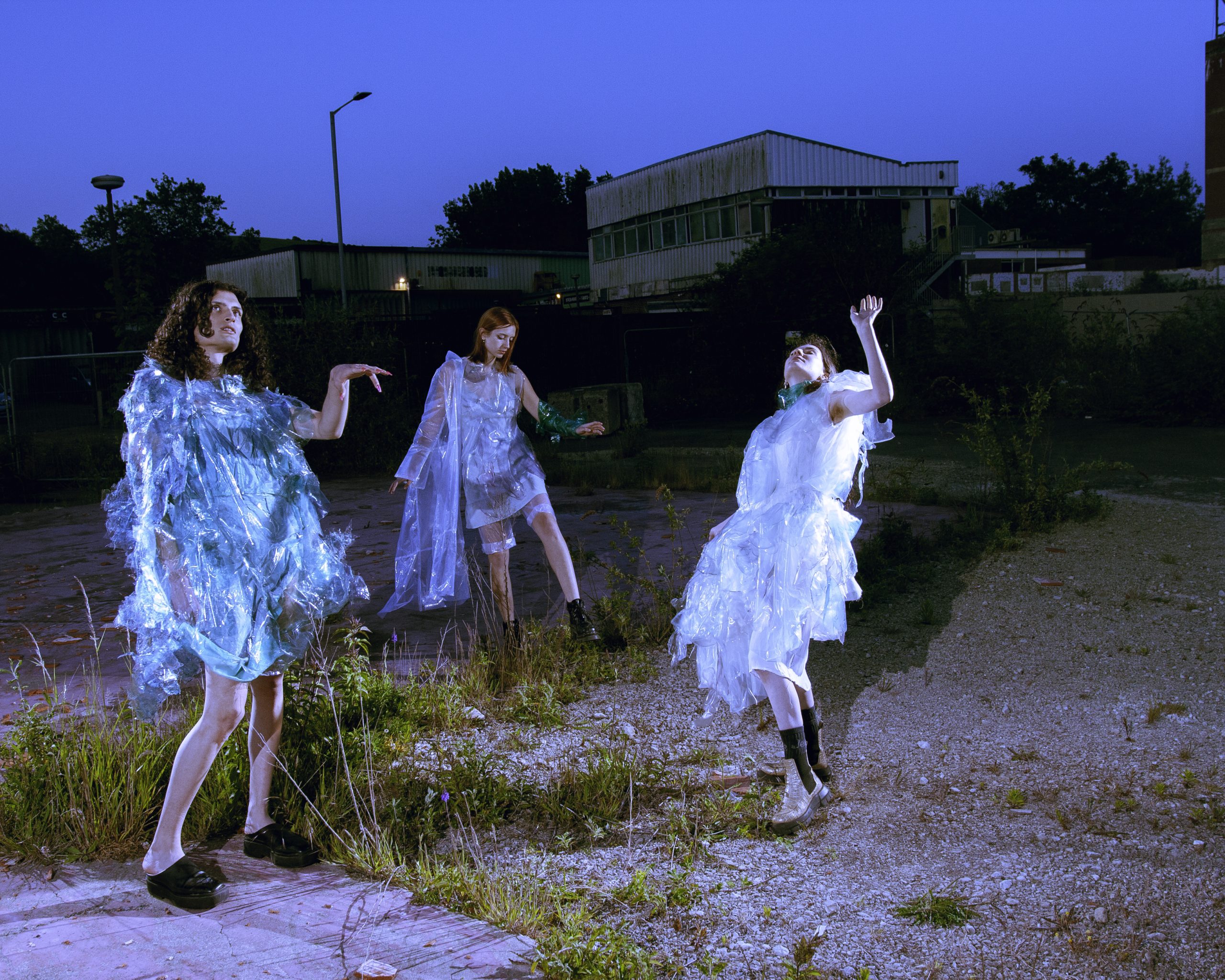
Brimilcombe has placed a strong emphasis – rightly so – on the fact that each look is fully compostable, and she reiterates how important it is that people know that. “I think my work accidentally often lends itself to sustainability,” she tells me, but with this collection specifically, she fought to ensure her morals weren’t influenced in any way. She’s even one of four winners of the H&M Sustainable Fashion and Journalism awards, recognised for her commitment to sustainability within her designs.
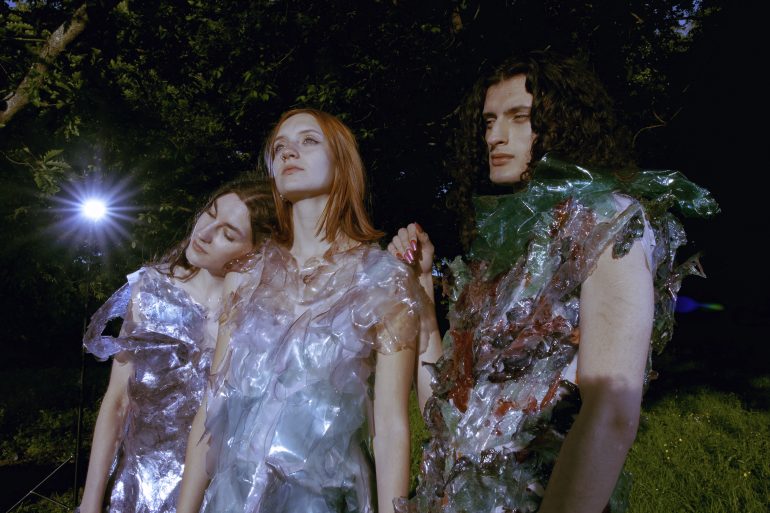
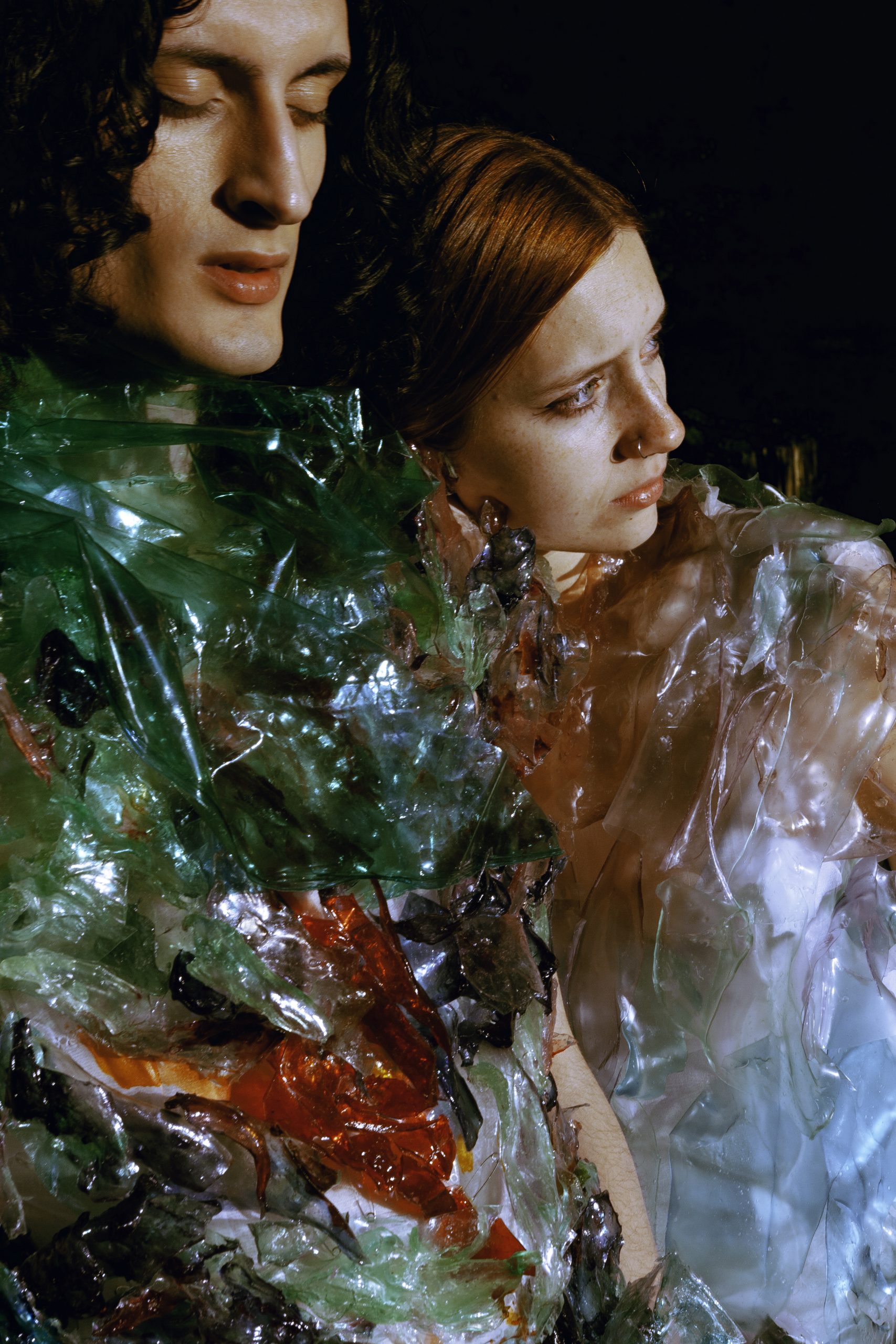
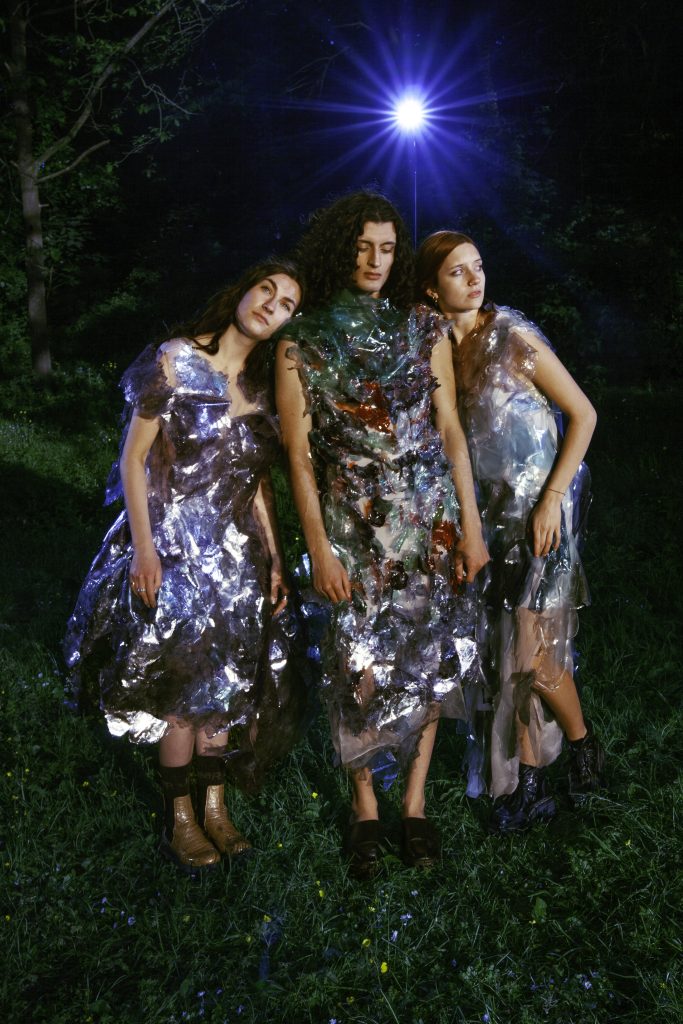
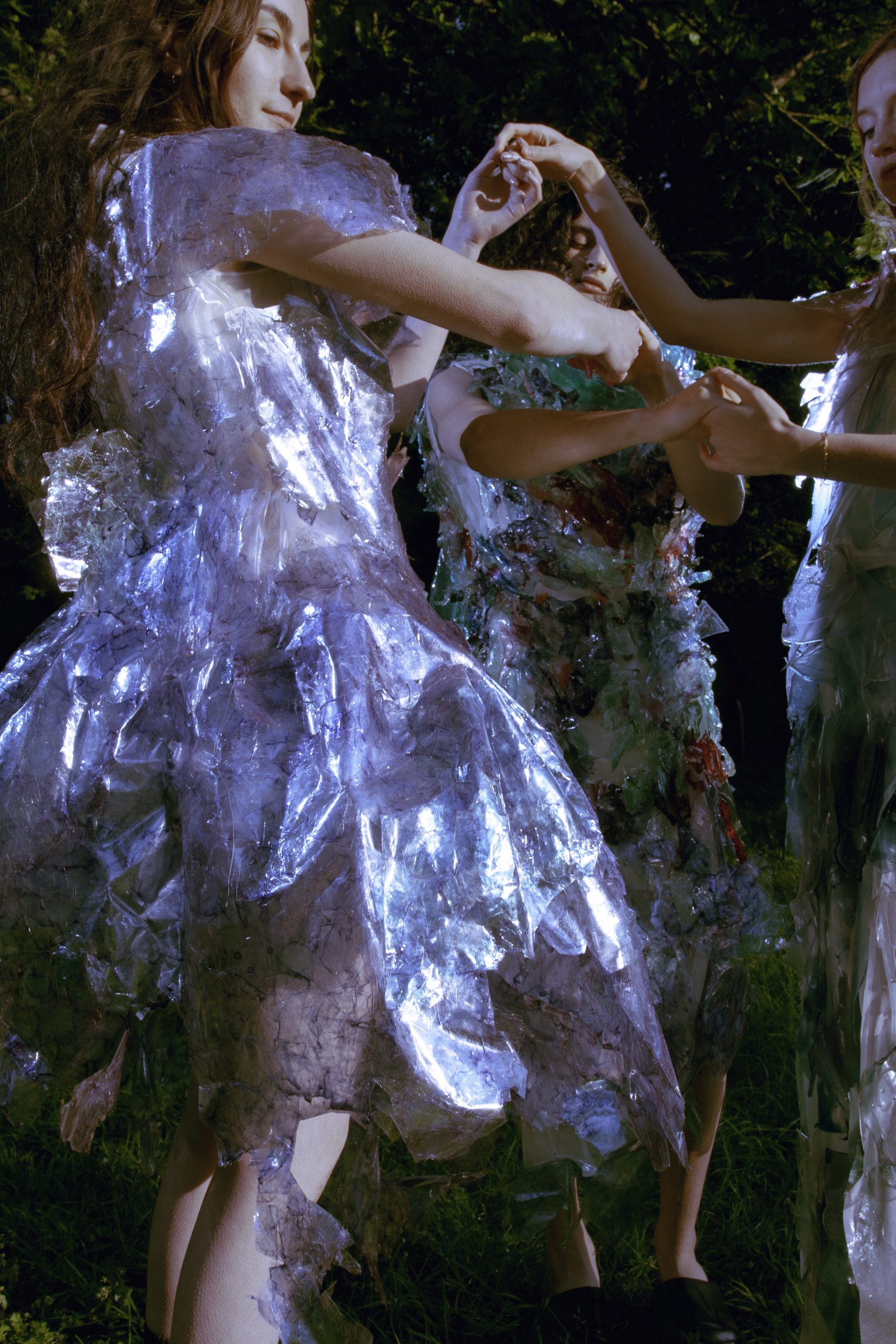
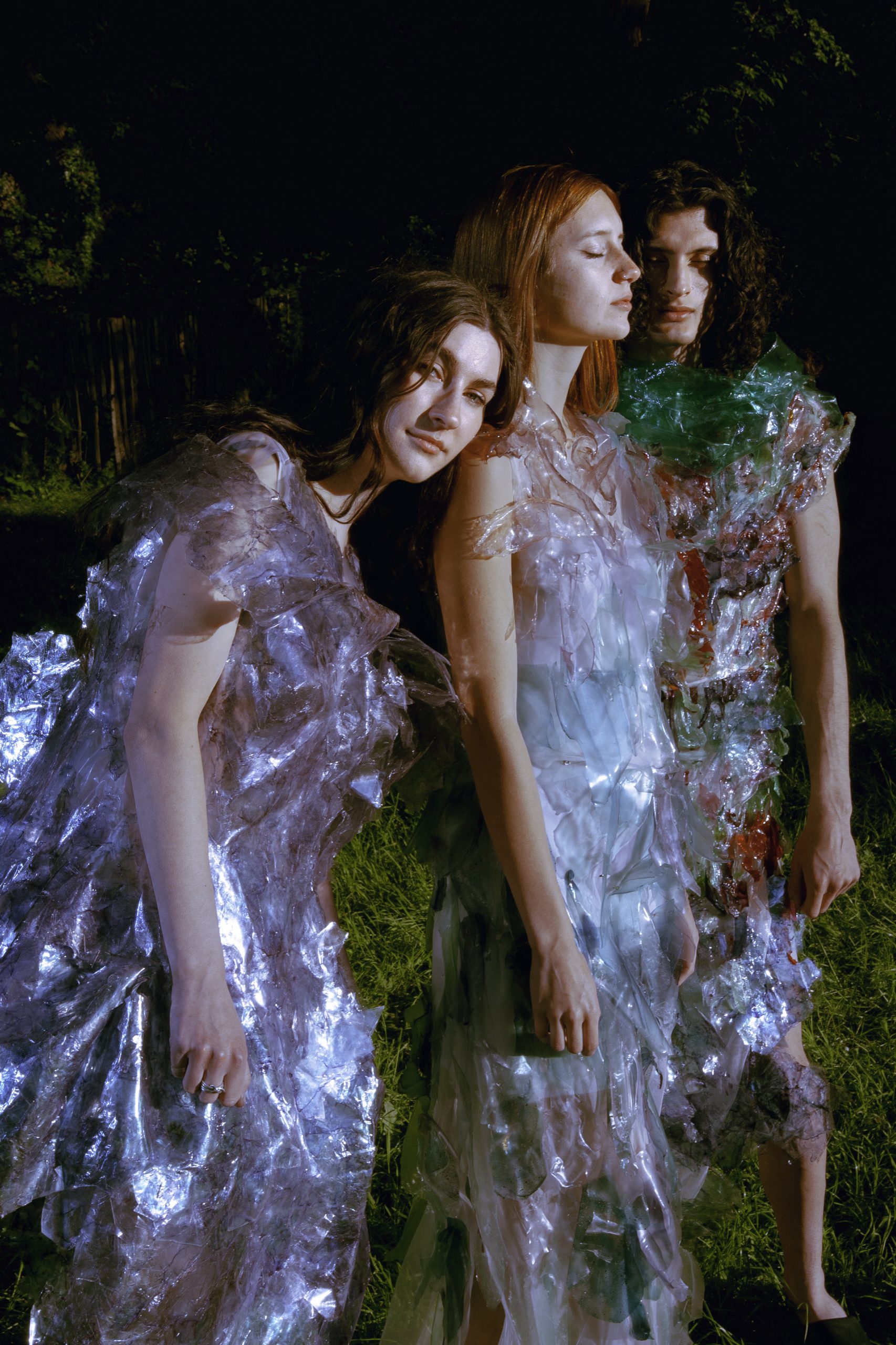
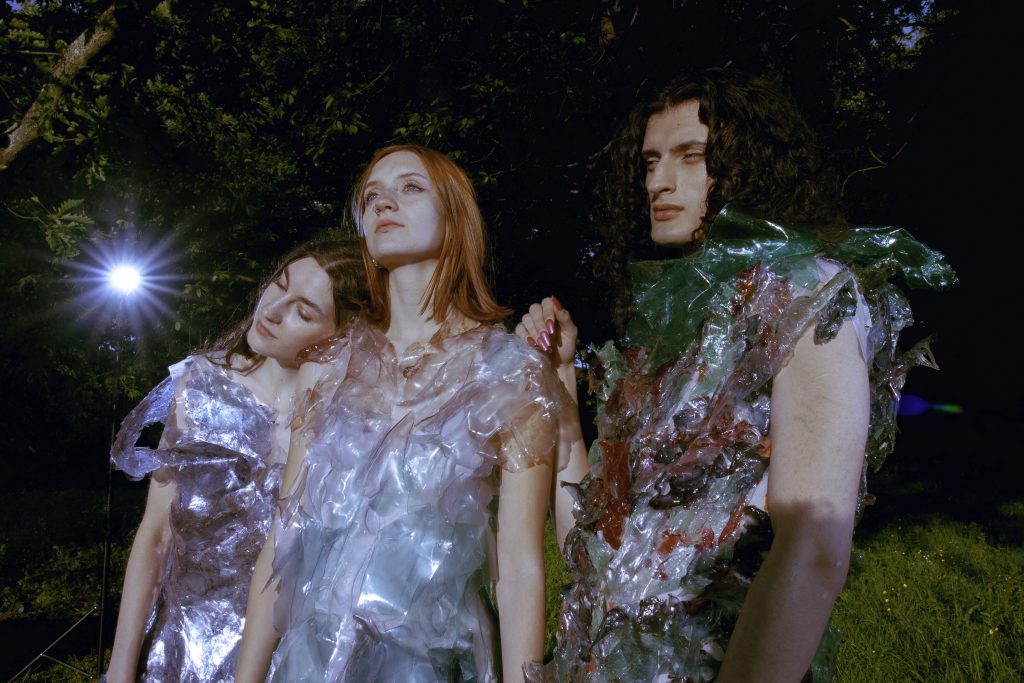
Constructing the bioplastic was a long and gruelling journey – full of praying the material would dry in time without getting mouldy and, once it did, that she’d have enough. “You have to treat it like a little baby, it’s so fragile,” she mentions. Composed of seaweed, glycerin, Agar powder, water, and cornflour – and dyed with food colouring – the mixture is heated and then spread on a surface to dry out. Playing around with the ingredients, and the thickness of the sheets, the collection features upwards of four distinctly different-looking bioplastics. “It’s hopefully deceptive as to what it is. Sometimes it looks a bit like melted plastic, sometimes it looks like flower petals,” she details.
The thinnest of the bioplastics is mixed with compostable cellophane to create an almost metallic-looking marbled finish. Though it appears the most fragile, it holds its shape, allowing Brimilcombe to explore a casted bodice and crinoline-esque structured skirt. The thicker, more bendable bioplastic is cut into various shapes and draped from silk organza, resembling water and on occasion, sea glass, especially with the predominantly blue colour palette. She comments on this, saying, “The reason it all turned out blue is because initially, I was trying to offset the naturally yellow tone of the bioplastic. Quite ironically, my mum’s old kitchen was turquoise.” She laughs, continuing, “It was funny because the project was more about other bits of my childhood and then I was like, ‘I am trying to move away from blue and nothing else looks good.’”
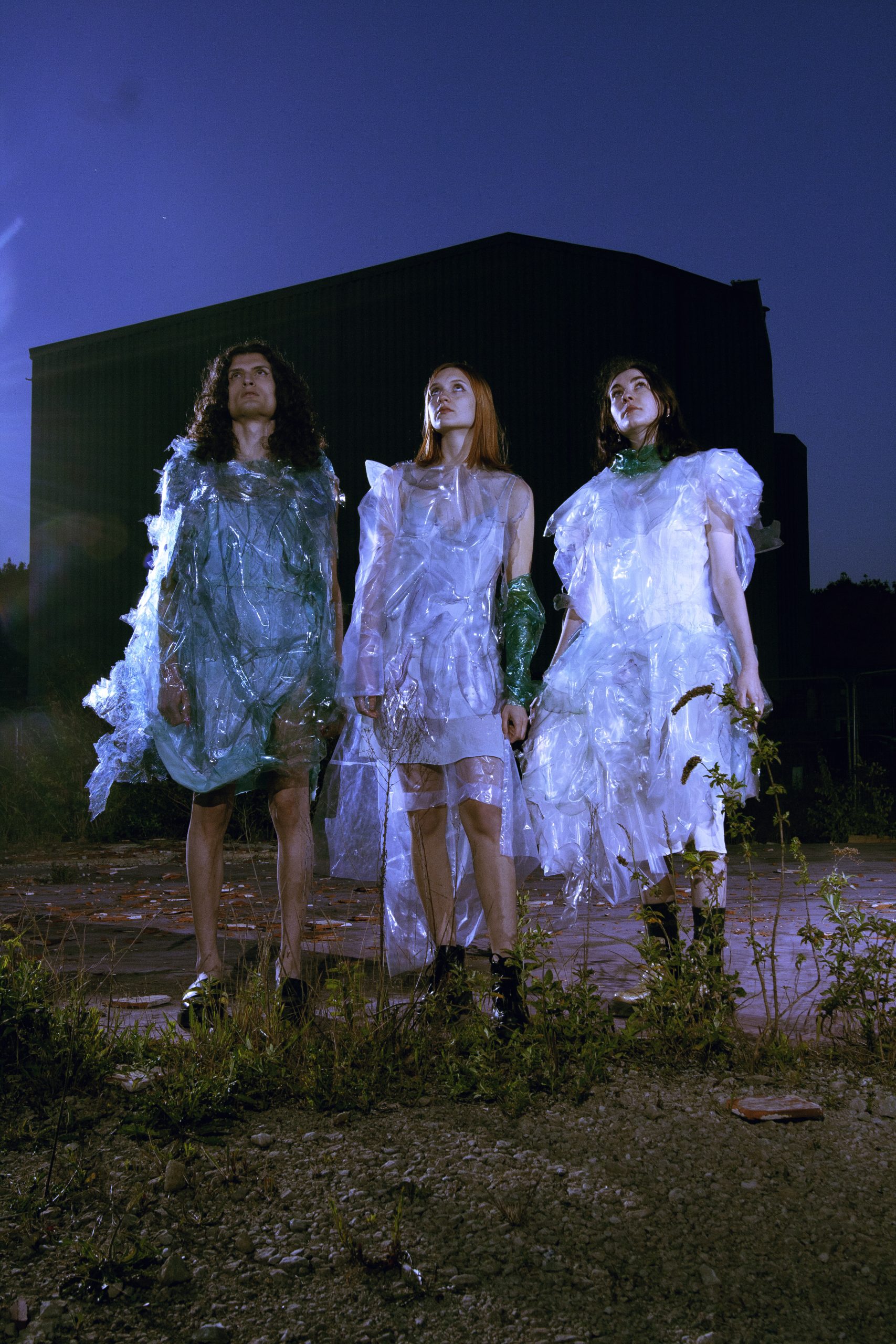
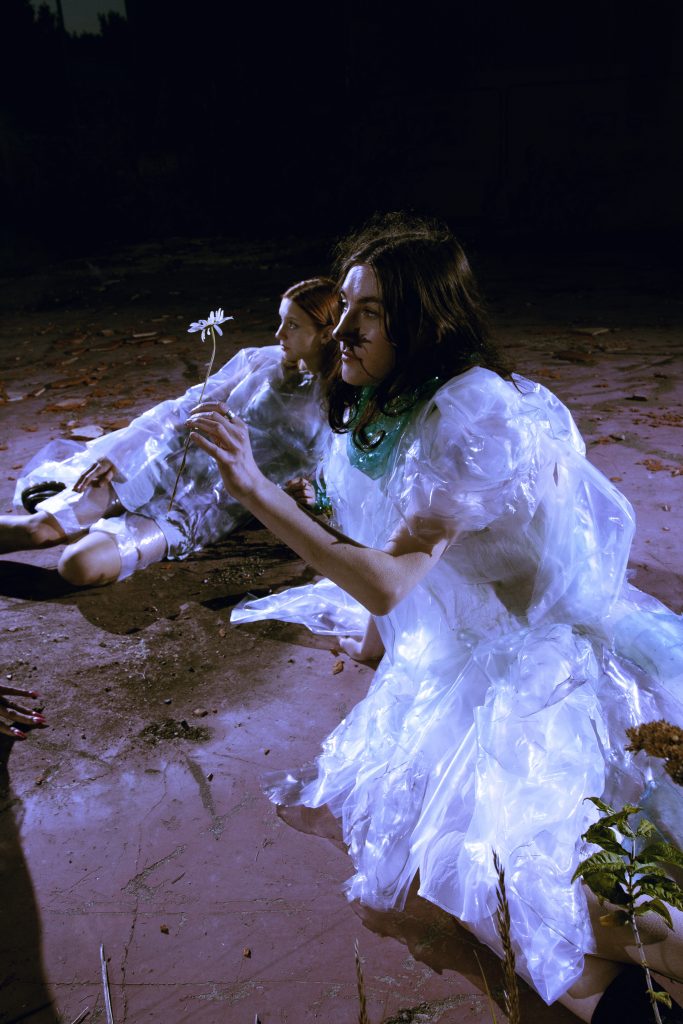
Since our very first chat, Brimilcombe has been adamant that her collection is not whimsical. When I ask why, she sighs, “Oh, God. I feel like it is, though. The colours, the materials, the way it’s so delicate… It does just look whimsical and that’s okay.” Her previous work is the polar opposite of her graduate collection. Disassembling bike helmets and old broken objects (think toy cars, train railway sets, and Nerf guns) she’s picked up from Deptford Market for next to nothing, she has built – and I say built and not designed for a reason – Transformer-style bras and corsets. Continually adopting a more powerful, gritty, and harsh aesthetic, she’s found it hard to lean into the ethereal nature her collection has taken on, saying, “I realised I needed to put that aside and stop cheapening what I’ve done by throwing something that’s already had a positive reaction at it.”
It was only until she realised, “It doesn’t have to completely define me,” that she was able to embrace the direction the collection had unknowingly – or maybe subconsciously – been steered in. With that being said, she’s eager to continue her exploration of bioplastic with the goal of mastering the (at times precarious) material. “Actually getting it to a place where it’s working – understanding materials, trialling and re-trialling – is tough,” she shares, “In reality, I need another year before I can make a bioplastics collection and I didn’t realise that going into it this summer.” While she can admit that creating her graduate collection has been one of the “most emotionally draining times of my life,” she’s surprisingly not burnt out from the stress and chaos which has encompassed the last eight months. As she tucks into a very late, very well-deserved lunch after spending the day rushing around pinning, tweaking, and pulling at her garments, she states, “If I stopped, I think I would just get depressed. I have to be making all the time. Even after this collection, I’ll feel tired, but it doesn’t stop me from wanting to make things.”
Follow Mia Wanaka Brimilcombe on Instagram
Words: Amber Louise
Photography: Joe Puxley
Designs: Mia Wanaka Brimilcombe
Models: Ava Brimilcombe, Katie, Alex
Assistant: Lou