

Ideas generate on a screen like a glitching roulette wheel. Edith Peony spins the wheel and lands on three unrelated images at a time. An archival garment, a photograph of road markings she has taken and something unrelated like a chair or a fruit. Peony gives herself three minutes to respond. Giving her no time to hesitate or refine the randomly generated combination. “It bangs out loads of ideas,” she says. Seventy-five sketches later, she might have six worth making.
I spin it until I find a combination I like and then give myself three minutes to design.
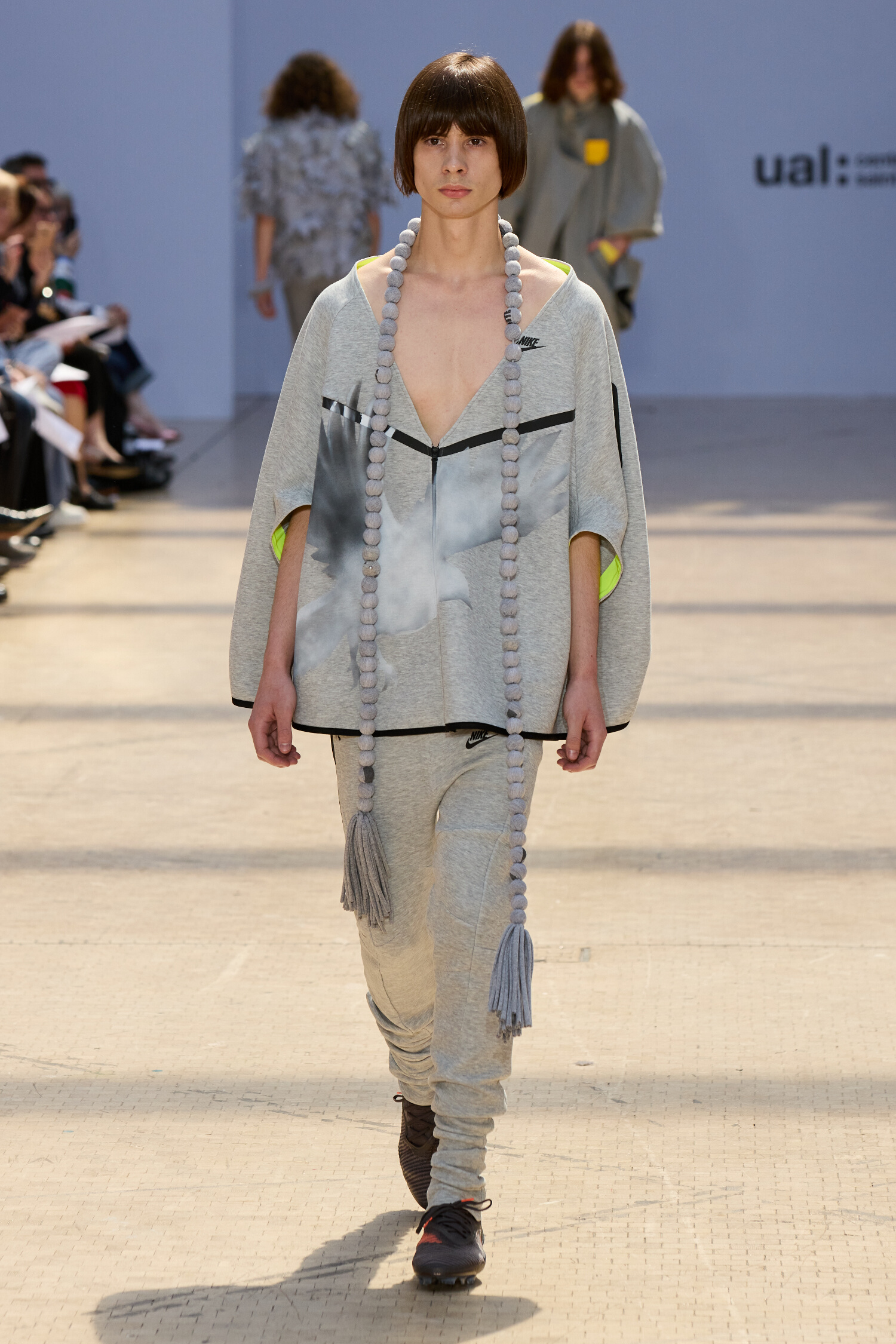
Peony, a final-year menswear designer at Central Saint Martins, has already accumulated the kind of momentum that tends to follow graduation. A placement at Louis Vuitton, support from a H&M scholarship, and a Nike-backed final collection; where – she says – Nike dubbed her as the “Jersey Queen” a nod to her long 3 year fixation and near exclusivity with the colour grey.“I’ve always worked in grey. Starting quite loosely in first year and then it became something I’m known for, especially on Instagram.” But the work she is building resists the idea of a polished result.“CSM (Central Saint Martin’s) has a way of doing things, and I think I was reacting to that a bit,” she says. “I tried to create a formula for how to design instead of just designing an outcome.” She argues this with a sense of assurance, as if she has been working through this idea for a while.
“I’ve always worked in grey. That’s kind of been my thing for three years.”
The “formula,” as she calls it, begins with a fascination with process. “I think I was getting frustrated with fashion,” she says. “It felt very focused on outcome, on spectacle. Like something exists once, on a runway, and then what?” there is a pause, “It felt a bit empty.” What she describes instead is a shift away from finality altogether: “So this was about shifting the focus back to process, designing something that could be used, repeated, shared. Almost like an exercise rather than a final object.”
“I’ve been testing it throughout the year, running it multiple times and tweaking things, But I haven’t really changed it that much, I’ve kind of committed to it.” When asked about her decision to shift her focus onto the process of designing, she says, “I’d been reading a lot of design theory, not fashion, more industrial design. Books like ‘Design, When Everybody Designs’ and ‘Speculative Everything.” She explains how in these books they are a lot more centred in how things are made and how “they function in the world.” Peony suggests how when you go back, and place an emphasis on the actual process, “Then the making can be slow, considered, sustainable.”
I think people have forgotten how important play is in design.
What makes this ‘formula’ quite time consuming is material. Peony works with an almost obsessive attentiveness to waste. Garments unpicked and rebuilt, seams taken apart and re-sewn, pieces held back rather than thrown away. “When I sew a line, there are two threads on both ends and I save those as well,” she says, matter-of-fact. Nothing is allowed to become excess. “It’s not just deadstock,” she adds. “I like taking it a step further. I’m saving everything.”
Peony grew up between the compressed bustle of Finsbury Park, the open landscapes of Scotland, and the suburban stillness of Rhode Island in the US. “I never had a massive connection to where I was living,” she says. “Like people have their childhood friends and I just don’t have that.” What remains from that instability is a kind of practical instinct, an ability to arrive somewhere and immediately adapt. “I just like to arrive somewhere and just get on with it.” Clothes, in her upbringing, were not treated as short-lived pieces. Instead in her house they were repaired and restored back into use. “If my jeans were broken, I would just have to fix them because I was not getting another pair for like another two years,” she says. Mending for her did not come from this conscious decision to be sustainable (although that was a benefit) it was a matter of having clothes at all. Even designing and making clothes began in the same economy of scarcity. “We didn’t have much money, so mending things was just normal.” Her mum made lingerie in a small studio, and taught Peony how to sew from the age of 8, so whatever offcuts her mum had, Peony would rework them for her dolls.
That natural instinct to salvage now seamlessly informs her design language. “I’m really good at upcycling stuff and cutting things up,” she says. “It’s like, how am I going to use that existing armhole? How am I going to use that existing seam?”.
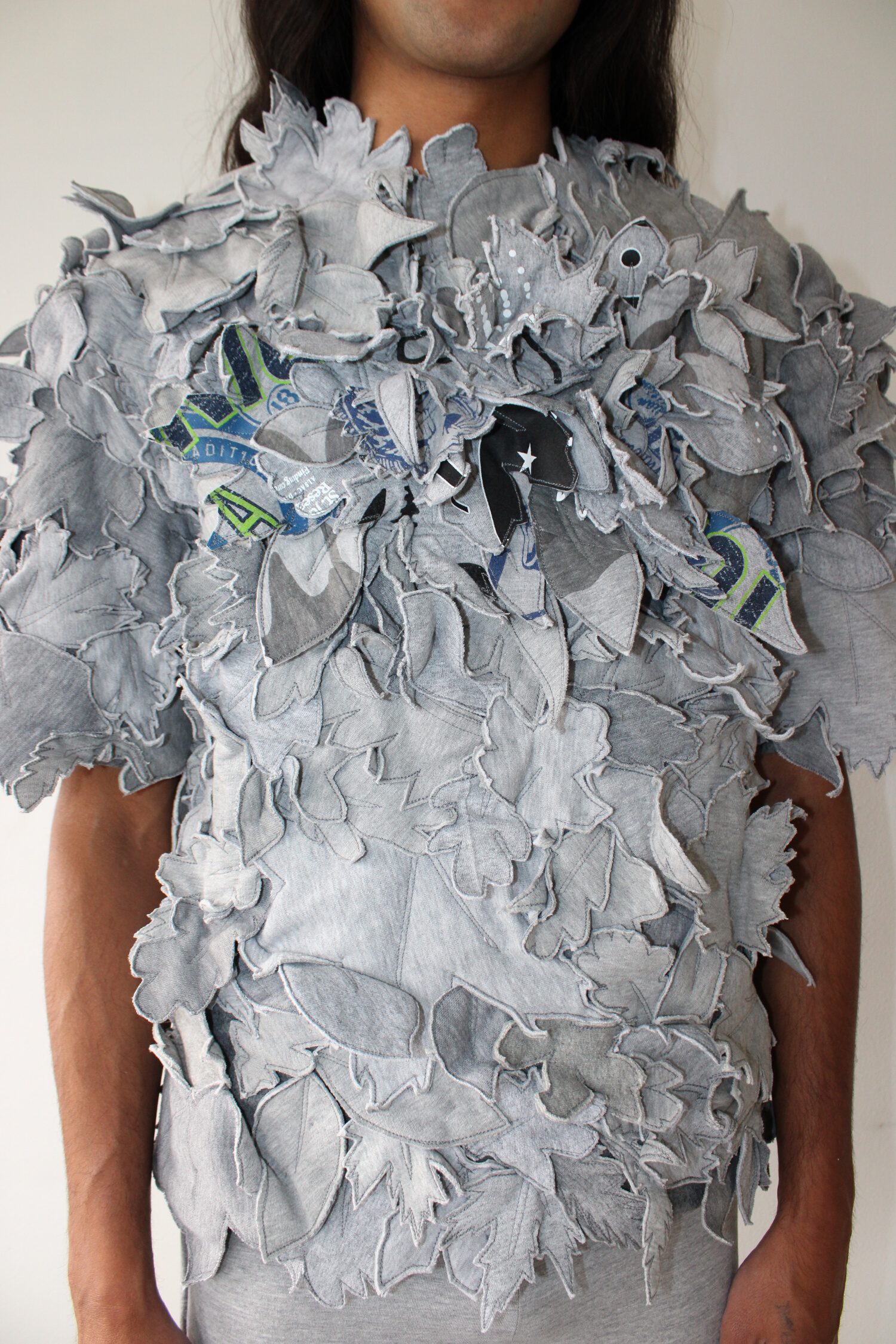
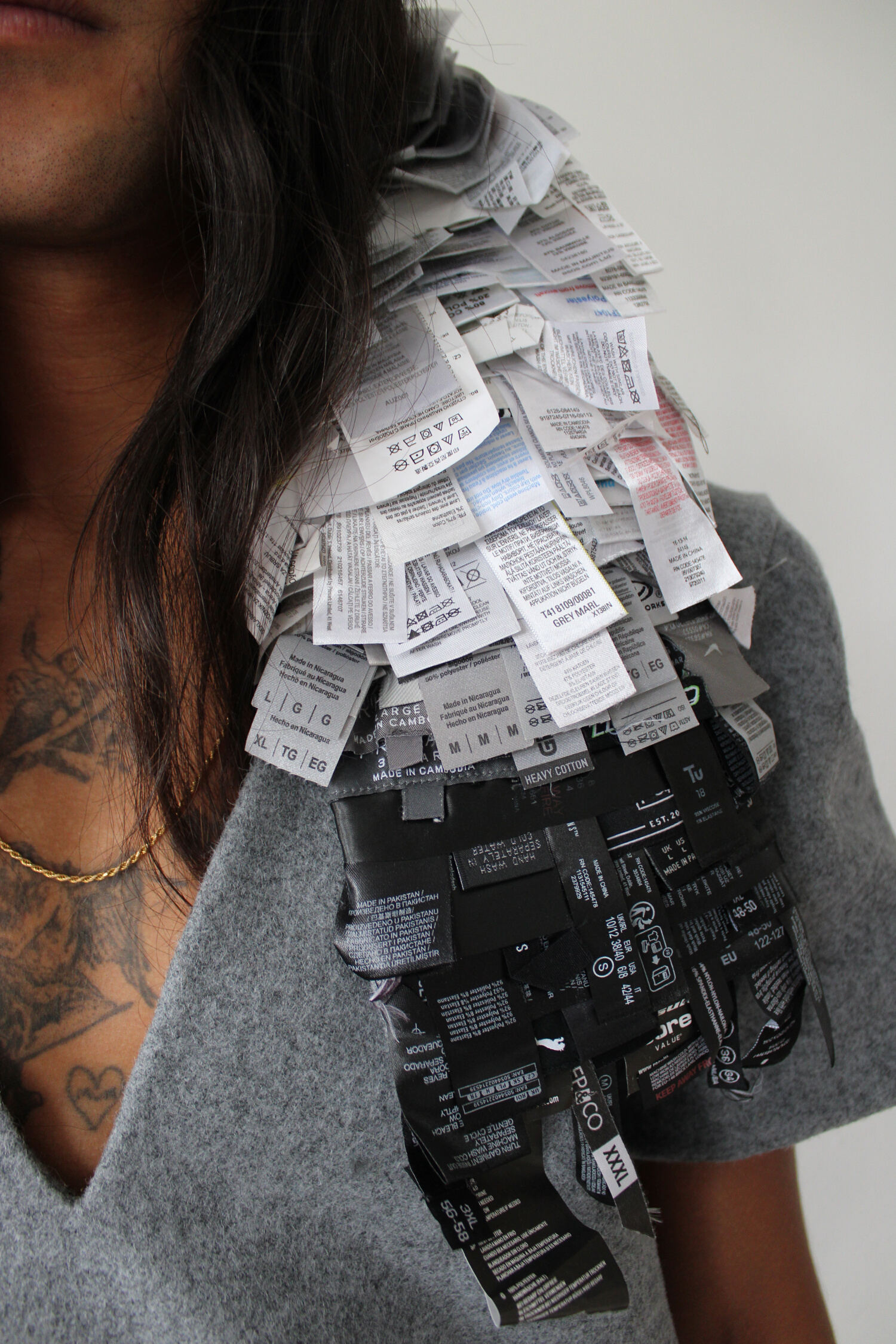
The main drawback she encountered during the physical making, is that it was a lot slower than the system of generated random combinations. “Everything is taking longer than I thought, especially because of how I work,” she says, weary. Her look one, she explains, is covered by leaf-like shapes made out of scraps, each one cut and put together by hand. Taking a lot longer than anticipated, where she also had her boyfriend spend all nighters to help her out. “Right now I’m making out of all my scraps. I’ve also got a zero-waste T-shirt top, a waistcoat with coattails, a jumper, and a top made out of blinds, which currently looks a bit like a shield, so I’m trying to fix that.” She comes across as a methodical designer, someone who’s quite step-by-step and has each moment quite well thought-out.
The way she handles her materials dictate much of this slowness. A t-shirt is cut down, then cut again. Even the smallest remaining scraps and sections are kept just in case. “If I cut up a t-shirt and there’s a tiny 5cm scrap left, I’ll keep it.” she explains. “Im really, really strict about that.” She also adds,“The problem is choosing what to actually make. I’m not short of ideas, I’m short of time.”
Outside of sketching and spending hours hunched over a sewing machine, Peony depicts a quieter set of routines that have little to do with design but plans her time around. She prioritises sleep, a rarity and unusual stance in fashion, she cooks and keeps her days relatively stable. “Its all quite grounding.”
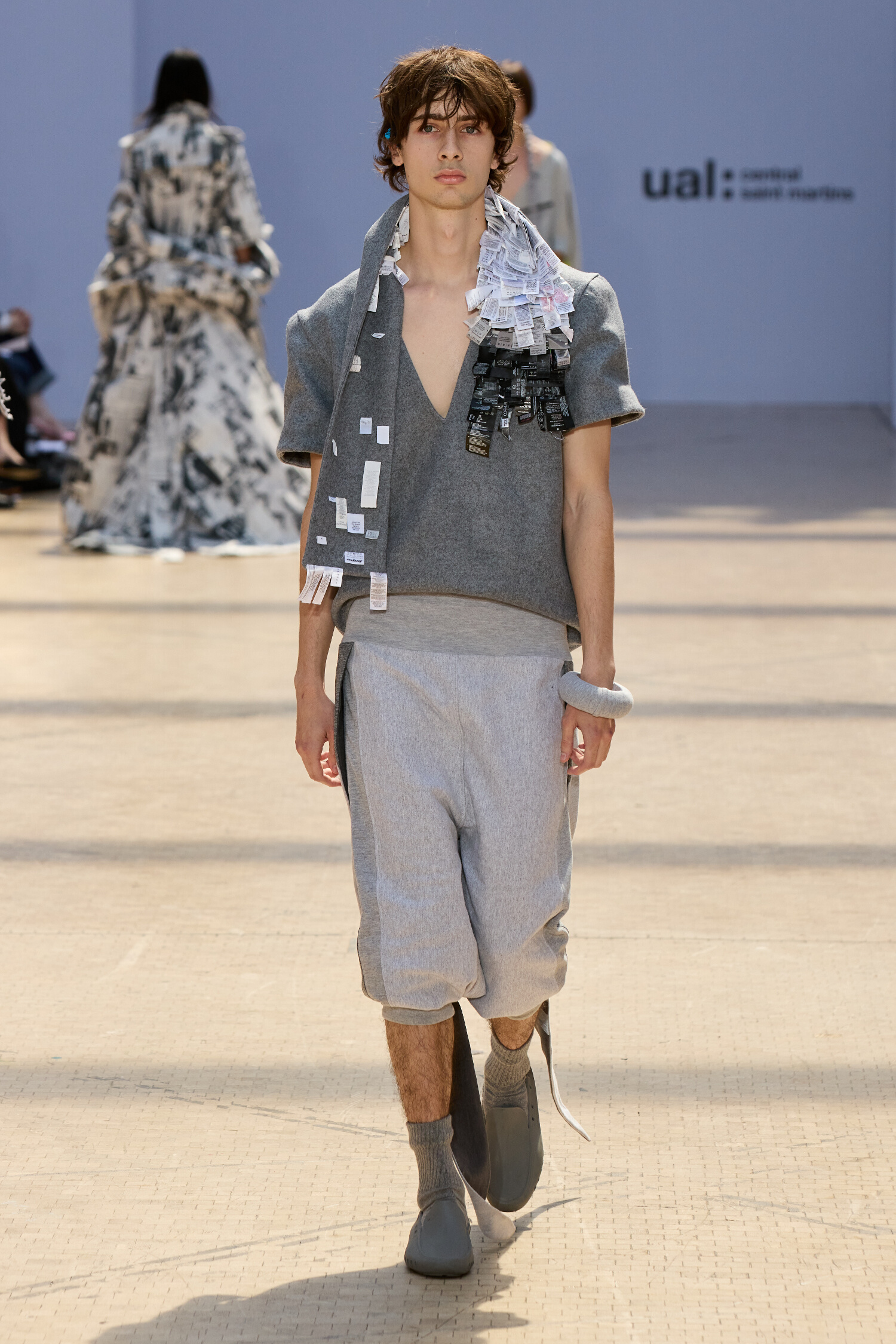
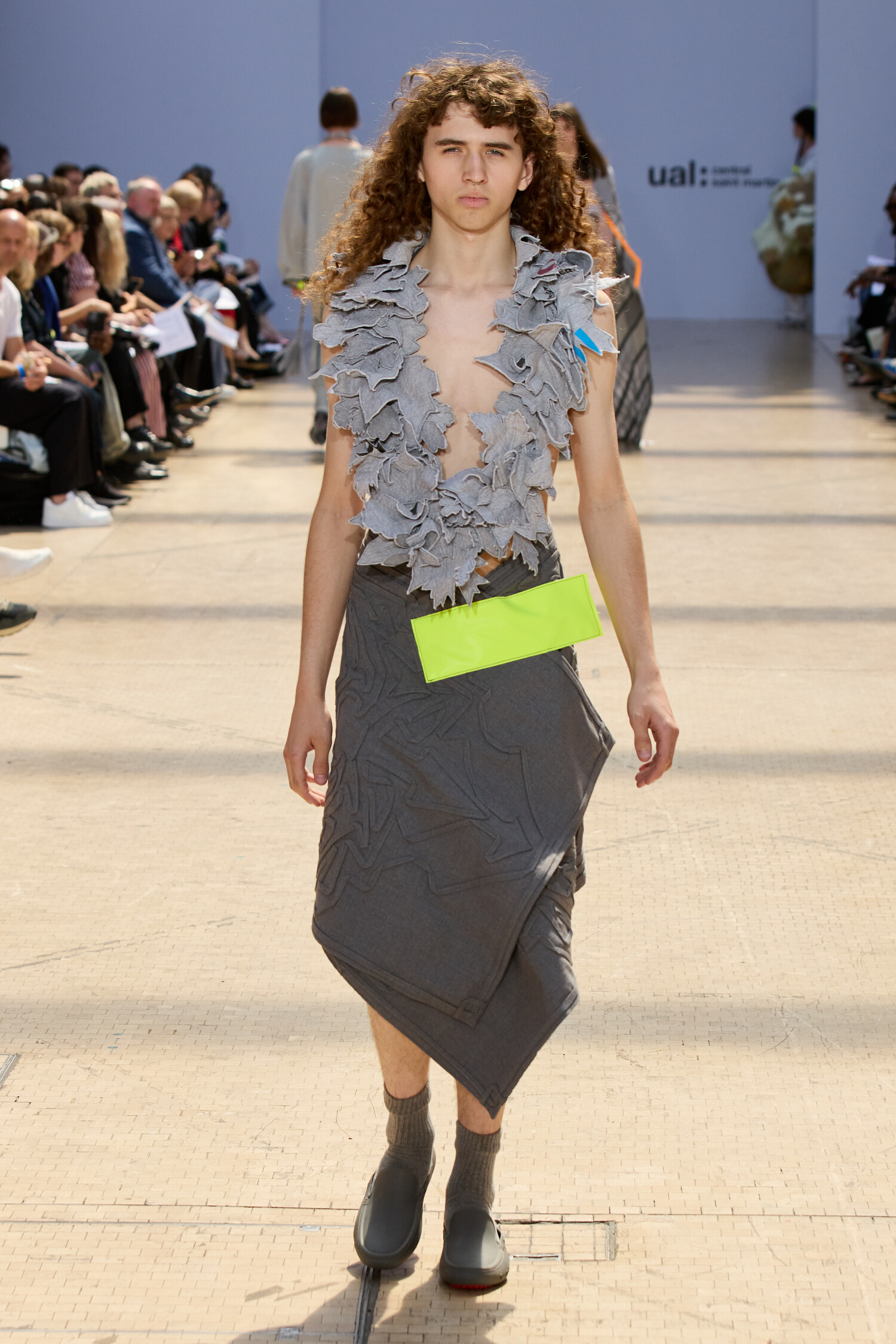
During an internship at Louis Vuitton, she says, the grand scale of production was made a lot clearer to her. “It made me realise how collaborative everything is. Nothing happens in isolation, everyone contributes small parts that build into something bigger.” This observation sits slightly removed from how BA fashion students are expected to make their collections, which is still largely done on your own.
Also, what helped her shape the trajectory of the collection, has been support from outside institutions. A scholarship from H&M and backing from Nike. “Nike came from just asking, basically,” she says. “A friend connected me, and we already followed each other.” The support translates into material supply particularly Nike tech fleece “Nike has sent me loads of tech fleece, and I’m ordering more to upcycle. She adds “ When I spoke to Nike they literally said, “This is perfect, you’re the Jersey Queen.”
This is perfect, you’re literally the Jersey Queen!
Her tutor, Louis Loizou, describes how she works, “She’s very good at working in a pared-back way,” He says. “She’s very good at creating her own fabric. She sometimes loses confidence and feels like she needs to add more. But she has a lot to work with.” What he identifies and points out is an excess that still needs editing, not a lack of direction or material, but a surplus from her formula that needs a considered streamline.
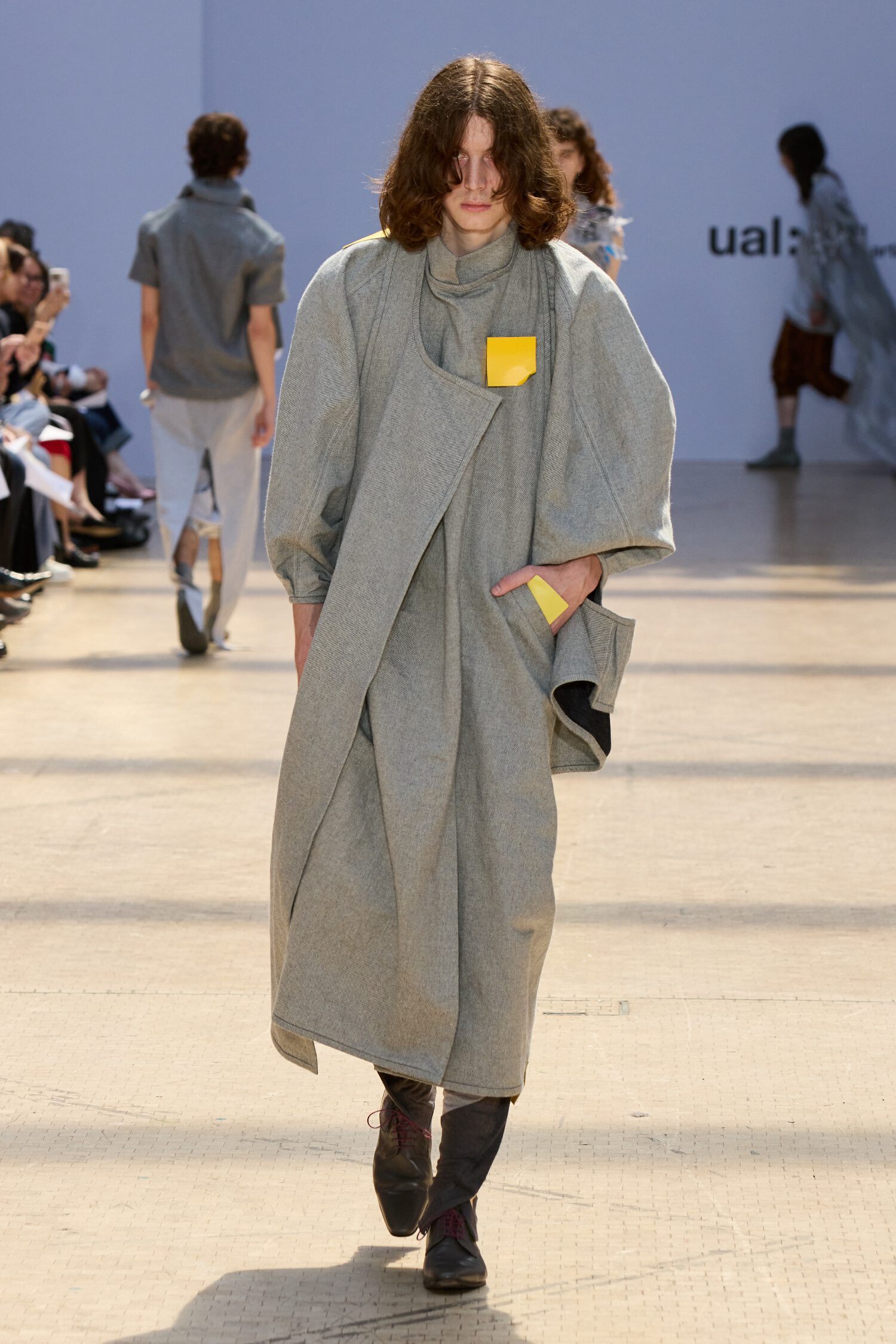
At the BA Fashion show at Central Saint Martins, what remained was a collection that, at first glance, avoided going overboard. Compared to the surrounding collections from other final year students, often theatrical, overtly constructed and densely styled, which isn’t a negative point, just a distinction worth pointing out. Peony’s work read as comparatively restrained. Greys formed the base across all looks, with small punctuations of neon, that resisted becoming decorative but more of a functional role.
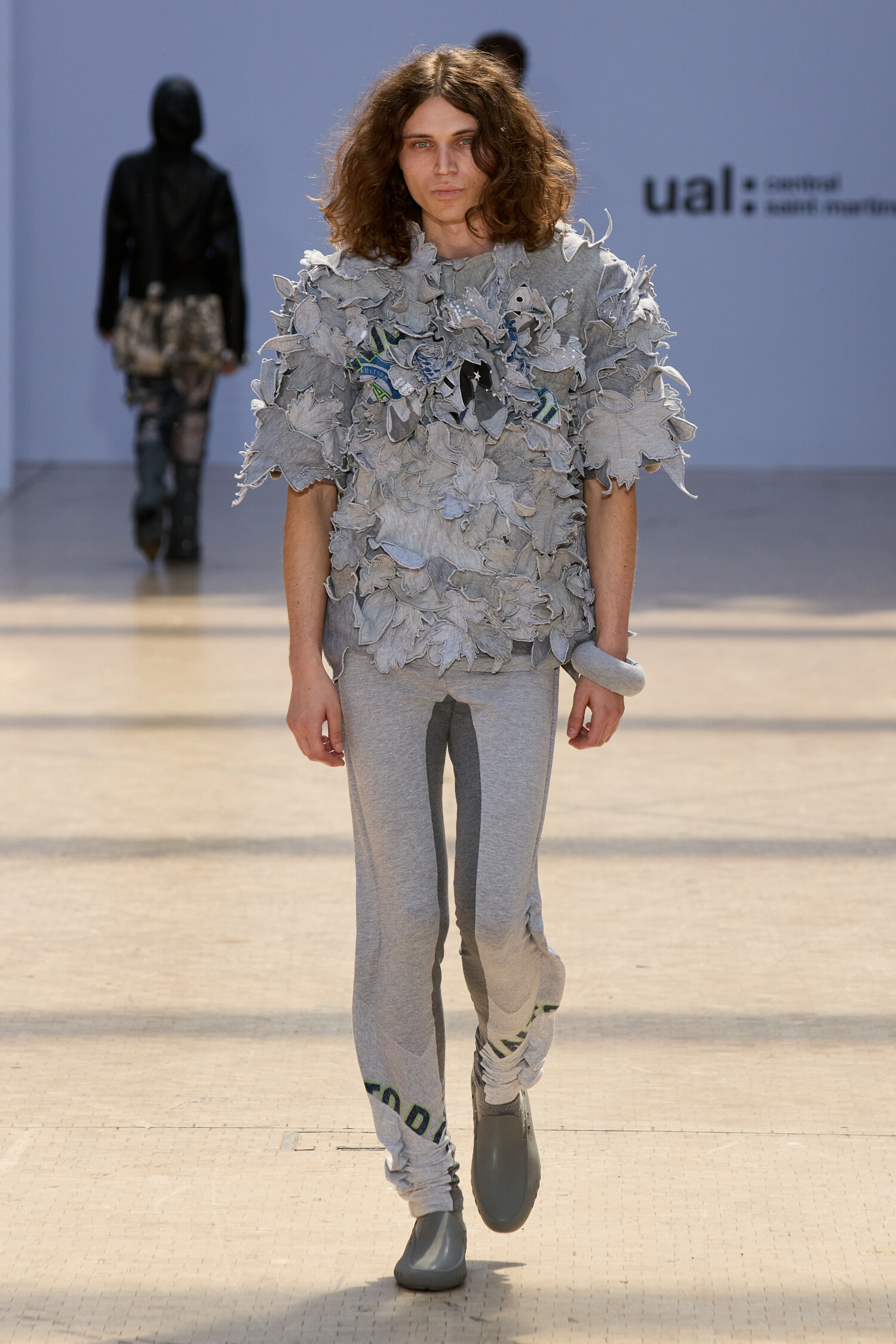
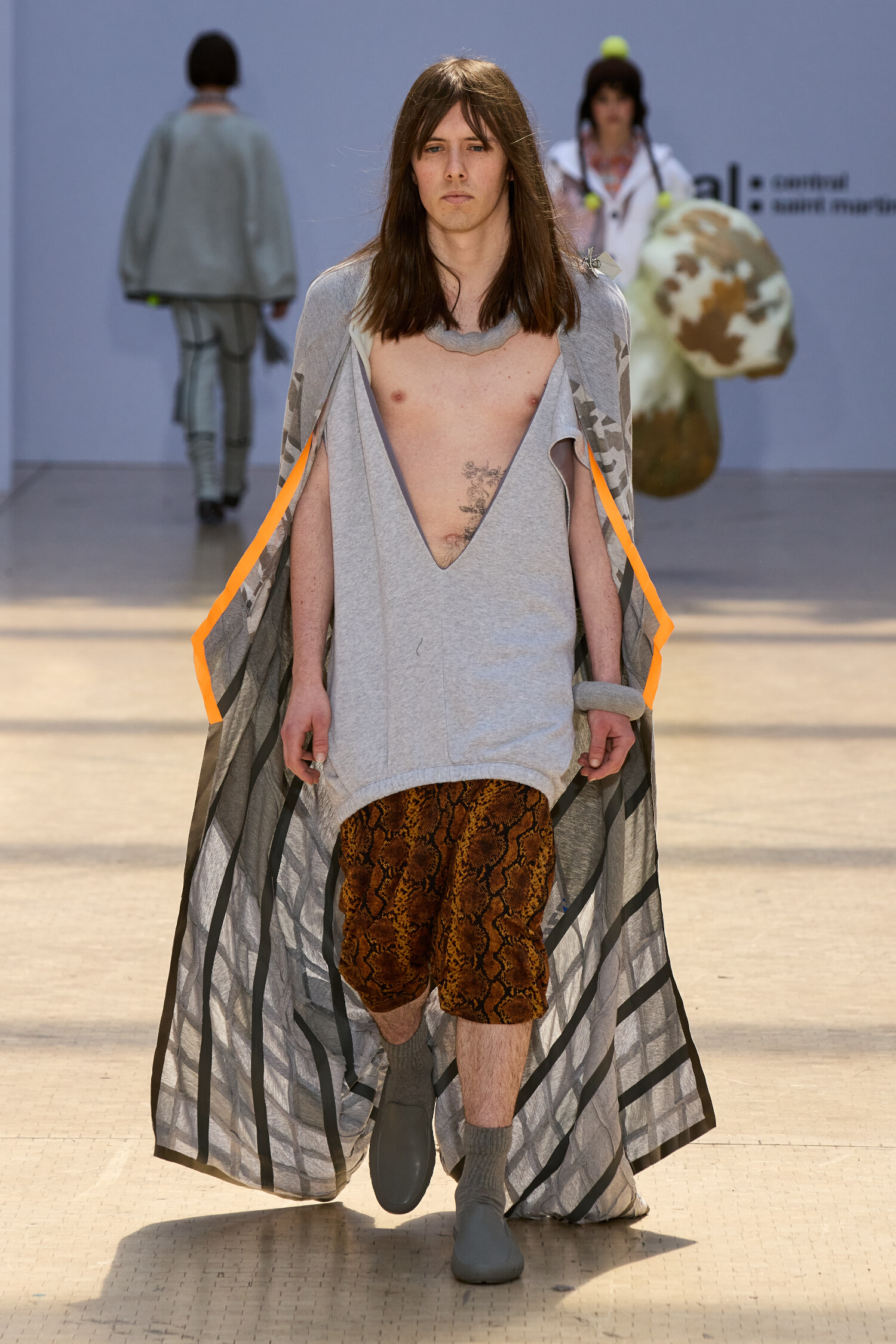
Those flashes of neon colours appeared like markers and references of her formula. In one instance, with look five, the yellow neon thick side strap recalled the “graphic lines, crosswalks and road markings on the ground” she photographs and feeds into her image system. Across the collection, these references appeared in flecks, not as literal translations. Look one, had a thick layer of constructed leaves as a top, it was layered, uneven, but organic in its pattern with some stacking over one another. It was clear it was a response from an image she took rather than an idealised idea of a foliage of a tree. What became clear in the show is that Peony’s work did not rely on literal theatrical markers to reveal its references. Her presentation was made up of moments where something familiar made itself clear after a second glance. It was that recognition and delay that made you think back to its process, and question, ‘what image could’ve inspired that specific colour in the seams?’ The greys, the neons, that silhouette that could have been inspired by a curtain, all pointed back to her system, her formula of sourcing images from everyday mundane found objects and environments: road markings, paintings, post-it notes.
At its core, the emphasis, finally, is on process. A formula that is transferable, a way of work that can continue to be inhabited beyond her.
My collection is about designing a process that somebody else can follow and repeat!
Follow Edith Peony on Instagram
Words: Mateo Carmona
Photography courtesy of Edith Peony