
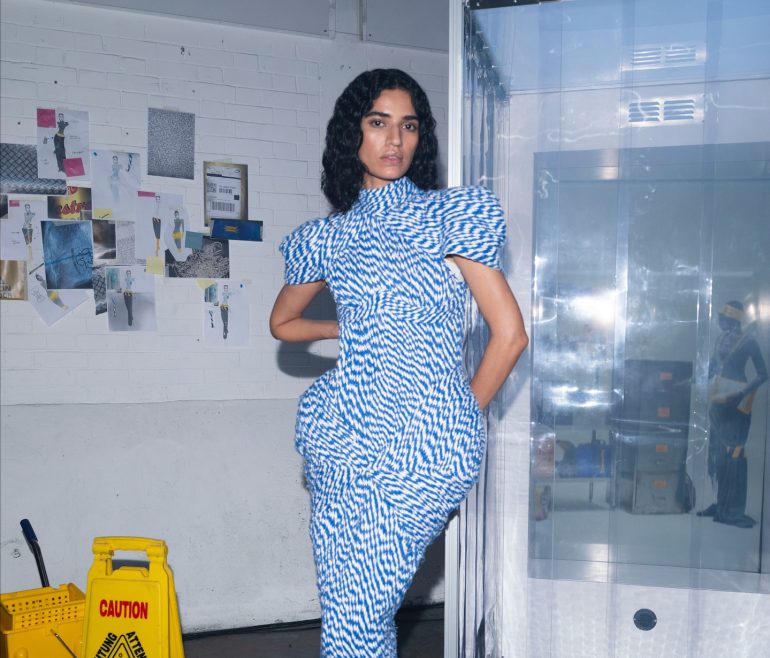
Ella Douglas first appeared on the fashion radar as part of 2022’s off-schedule Fashion Scout platform, which runs concurrently with London Fashion Week. Last season saw her debut on-schedule appearance as part of the official LFW programme with A/W 26 collection “Yellow Pages”. Inspired in part by the clock-watching Monday to Friday drudgery of those unable to escape the 9 to 5 hamster wheel, Douglas’ latest collection references an environment that – despite 21st century technological advances – still possesses an ennui little changed from analogue days. Taking its name from the encyclopedia-sized telephone directories that fulfilled the role of a search engine in those distant pre-internet days, the “Yellow Pages” analogy manifested itself materially in the fabrics and fixtures used to make the collection. Items such as mop yarn and pegboard metal hooks. Items redolent with an early 2000s office ambience that spoke to the collections vision and Ella’s ethical values.
That storytelling arc was further evinced through the set used to showcase her pieces. Entered through PVC curtains, one was led into the type of seedy space that might still be found on off-motorway industrial estates. One that’s part-office, part-workshop, illuminated by fluorescent strip lighting and defined by its tired, spartan decor. It’s an
environment that Ella turned on its head, imagining a lesbian workforce who find beauty in the crushing mundanity that surrounds them. A visualisation that explored the duality of femme in function and challenged the heteronormative hegemony often associated with such working environments.
Ella showed at the Shoreditch venue Unlocked alongside fellow CSM student Timisola Shasanya, with both presentations being preceded by another Saint Martins alumni Maximilian Raynor’s runway show. It was a triumvirate brought together under the Hi-Fi umbrella, a groundbreaking non-profit organisation that seeks to nurture emerging
creative talents and turn potential into lasting industry success. The brainchild of Liam Gleeson, creative director and founder of Hidden Agency, a multi-disciplinary incubator with offices in London and Tokyo, the parent company reinvests a percentage of its commercial income into Hi-Fi, who in turn use those funds to empower new voices
and provide them with a launchpad.
Noctis speaks to Ella about her latest collection, the impact that Hi-Fi’s support has had on the brand and her future plans and aspirations.


Congratulations on your LFW debut collection “The Yellow Pages”. What influences and inspirations did you draw from to create the pieces?
Thank you so much! The main inspiration for my latest collection came from the office and loading bay environment I found myself in from 9 to 5 every day. When you’re working in a quiet office, your mind starts to wander, you begin scanning the room for something to spark your imagination rather than just watching the clock. I decided to turn
that daily backdrop into the foundation of my creative process. Being a very tactile person, I drew inspiration from ordinary, overlooked details; the mop flung in the corner, the textured metal flooring, and the strips of hazard-yellow tape that decorated the space.
The collection’s title references a more analog time – what message you wanted it to convey ?
The collection title “The Yellow Pages” is meant to transport the audience back to a pre-digital era. The yellow pages feels almost obsolete today, and I wanted to evoke that sense of nostalgia for things that have been left behind. I found inspiration in an office that hasn’t changed since the early 2000s, filled with old machines that were still
somehow working perfectly. It made me question our obsession with constantly upgrading: if something isn’t broken, why fix it? Why are we always chasing the newest, shiniest tools? The name felt like the perfect way to encapsulate the outdated office environment and the world I was building through this collection.
How would you describe the Ella Douglas aesthetic, your vision and your values?
I think the Ella Douglas aesthetic explores traditionally male-dominated industries and reimagines them through a queer lens. I’m drawn to polishing spaces that are often seen as rough or utilitarian, transforming them into something refined. My goal is to take inspiration from the mundane and industrial, and translate those everyday aesthetics into
artistic pieces that people genuinely want to wear.
Can you tell us about the fabrics and materials you used to make “The Yellow Pages” and how intrinsic they were to the story you were telling?
I really wanted to explore contrast throughout the entire collection, so the interplay of different fabrics became a key focus. I loved the idea of pairing delicate knits with metal hooks, elements that could unravel the fabric in an instant, to create a sense of tension and fragility. I also combined leather with classic office suiting materials, echoing the
contrast between the industrial estate and the corporate workspace that inspired me. One of the main fabrics I worked with was mop yarn, which I used to create intricate, delicate embroideries. I actually sourced the yarn directly from a factory that produces thousands of mops a day, they even sent me over a hundred different colour ways to choose from! I had no idea there was such a vast world of mop materials to explore.


That holistic process was enhanced by the set you used to showcase them. Was that atmosphere and ambience something you envisioned while creating the pieces or something that the show space allowed you to explore?
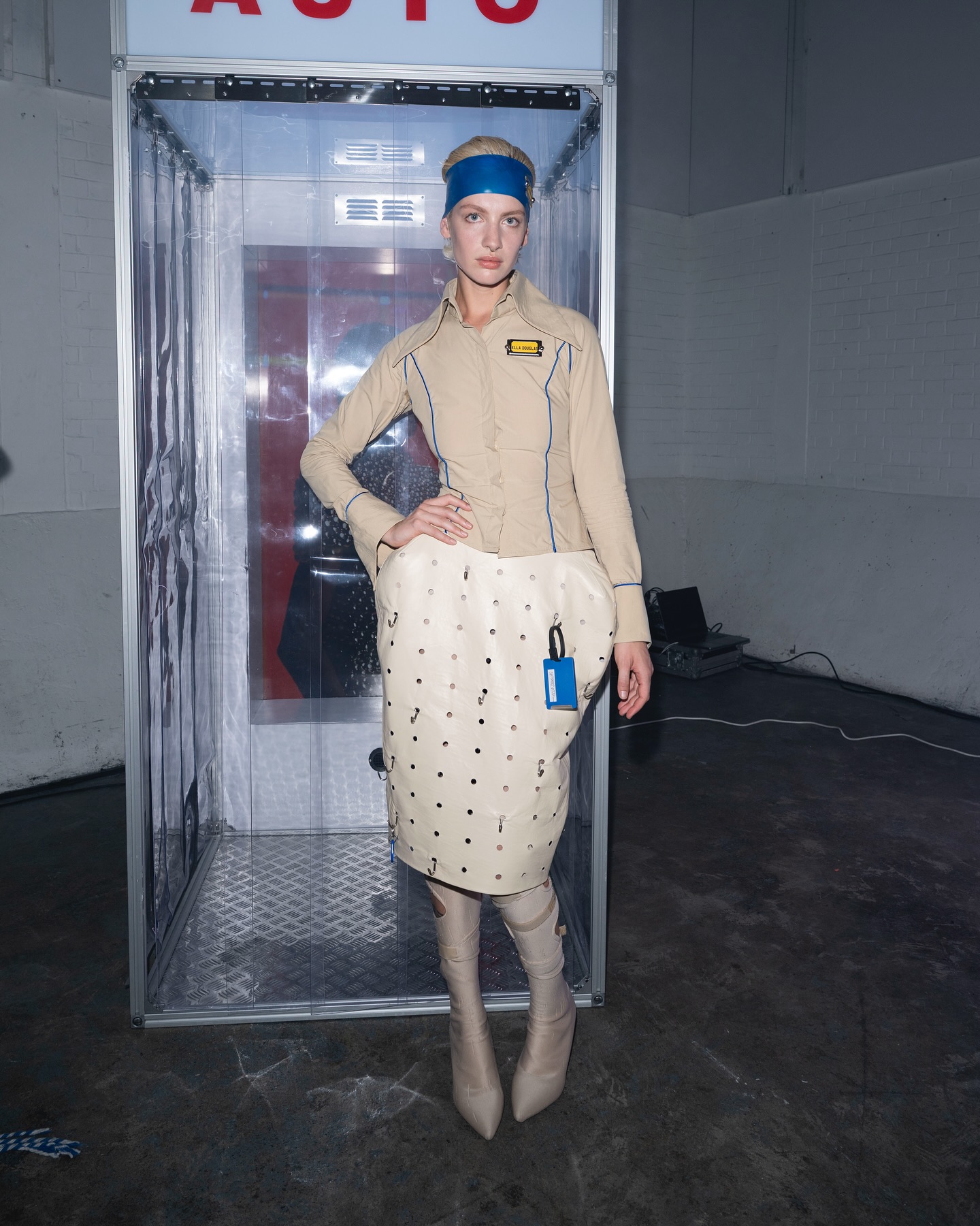
From the very beginning of designing my collection, I knew that set design would play a huge role in drawing the audience into my world. I’m genuinely obsessed with set design. It’s something I’m deeply passionate about, so I was incredibly grateful to collaborate with Hannah Knowles, an amazing set designer who brought the office-loading bay
world to life. There are so many subtle connections between offices and garages, like the use of blinds, PVC strip curtains, and industrial materials, and the set became the perfect way to merge those elements and create an immersive, cohesive atmosphere for the collection.
You showed as part of the Hi-Fi initiative with Timisola and previous Hi-Fi recipient Maximilian Raynor. How did that come about and how valuable has Hi-Fi’s support been in providing that platform and exposure?
Liam, the founder of Hi-Fi, first reached out after seeing a window display I created in Oxford. We later discovered that we’re actually from the same hometown, which was such a surprise! You don’t often meet people in the fashion industry from a small (and slightly uneventful) town in Oxford. From the start, Hi-Fi really understood my design ideology, and I felt genuinely supported and uplifted as a young emerging designer. I think sharing that hometown connection gave us a mutual appreciation for being part of London’s creative scene and a shared drive to push boundaries and create space for new voices in fashion.
What are your immediate plans as we head towards 2026 and your longer term ambitions for the brand?
It’s been a really busy period since showcasing my SS26 collection at London Fashion Week. My team and I are now putting the collection into production, which will be released soon, and we’re also developing some exciting new projects while beginning research for AW26. Looking ahead, my long-term ambition for the brand is to establish it as a recognisable household name. More than anything, I want to see people wearing my designs in their everyday lives. There’s something incredibly rewarding about spotting someone on the street in one of your pieces. That’s what motivates me to keep growing and pushing toward becoming a truly well-known designer.
Follow Ella Douglas on Instagram
Read our interview with Hi-Fi Founder Liam Gleeson
Words: Brian James
Photos courtesy of Hidden Agency