The Louis Theroux Podcast is available on Spotify now
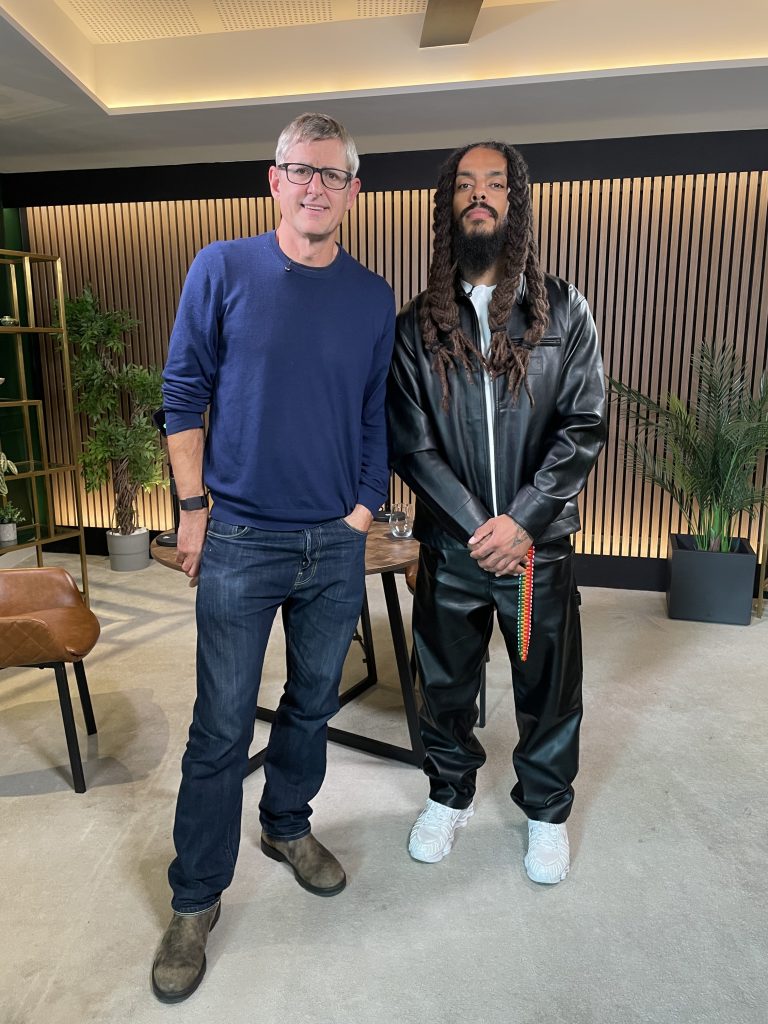
This week, Louis sits down with one half of punk-rap duo Bob Vylan, who performs under the eponymous pseudonym Bobby Vylan. The band came under intense scrutiny earlier this year following a chant against the Israeli Defence Force started during their set at Glastonbury. The performance prompted apologies from the BBC and Glastonbury, as well as triggering a police investigation.
In his first-in depth interview since Glastonbury, Bobby and Louis discuss the intricacies of what happened at a set than changed not only the band’s personal lives, but had socio-political ramifications that rippled across the globe. He and Louis also explore broader conversations about free expression and the challenges faced by marginalised voices in UK politics.
Louis: You could argue it became a massive distraction, right? And maybe was deliberately weaponised as a distraction tactic. Owen Jones said in his commentary, a day earlier – this is before Glastonbury – the Israeli newspaper, Haaretz, revealed that Israeli soldiers and officers had confessed they’d been ordered to shoot at unarmed Palestinians as they queued for aid. At the same time, Ted Cruz, the American Senator is using you and the chant as a stick to beat anyone who disagrees with Israeli policy. That’s an American senator with a huge international profile… you could argue that it gave them an opportunity to distract millions of people, hundreds of thousands of people, and say, this is the problem. It’s not civilians being bombed and killed, and children being bombed and killed in Gaza. The problem is, we got a punk rock artist saying, “Death to the IDF”. That becomes an opportunity to misdirect.
Bobby: Yeah. But then even with you saying that, like listen to how ridiculous it sounds. Do you know what I mean? It’s ridiculous.
Louis: I think it kind of worked for some though, didn’t it?
Bobby: I think shortly after they were done battering us, the tides started to change a little bit.
Louis: In what way?
Bobby: Well, I think having to have that conversation about the chant as they were all having amongst themselves. It created this discourse within the media of, is the chant right? Is it okay to say, is it this is it that, and then that gave platform to certain people, maybe like Owen Jones. That would come on and say, well, actually this is what we should be focusing on. We need to focus the attention back onto Gaza, back onto the people of Palestine, and he’s laying out facts and presenting his argument. I think it allowed for that conversation to have a new life almost, because unfortunately, people have short attention spans and watching people being killed every day in real time for the last two years, so vividly, so prominently. I think a lot of people just got numb to it. They stopped even seeing these individuals as actual people, start seeing them as numbers. It’s disgusting. Who cares about the chant? Why is that the conversation that they’re having? But I do think within that conversation it allowed us to bring the issue back to the front page.
Louis: Do you stand by the chant, and would you chant that on stage now?
Bobby: Oh yeah. Like what if I was to go on Glastonbury again tomorrow, yes I would do it again. I’m not regretful of it. I’d do it again tomorrow, twice on Sundays. I’m not regretful of it at all, like the subsequent backlash that I’ve faced. It’s minimal. It’s minimal compared to what people in Palestine are going through. If that can be my contribution and if I can have my Palestinian friends and people that I meet from Palestine, that have had to flee, that have lost members in double digits of their family and they can say, yo, your chant, I love it. Or it gave me a breath of fresh air or whatever. And I don’t want to overstate the importance of the chant. That’s not what I’m trying to do, but if I have their support, they’re the people that I’m doing it for, they’re the people that I’m being vocal for, then what is there to regret. Oh, because I’ve upset some right-wing politician or some right-wing media?
Bobby Vylan calls Damon Albarn’s comments on the Glastonbury chant ‘disgusting’: “I just want to say that categorising it as a spectacular misfire, implies that somehow the politics of the band or our stance on Palestinian liberation is not thought out.”
Bobby: Who else did you find who was basically critical?
Louis: I mean, there’s quite a few of them. Well, you know this one, because you responded. Damon Albarn from Blur said, “it was one of the most spectacular misfires I’ve seen in my life, especially when he started goose-stepping in tennis gear”.
Bobby: Yeah.
Louis: I think he was being hyperbolic. I know Damon a little bit. I’m declaring an interest.
Bobby: I think there’s no space to be hyperbolic in that. Especially given what we were accused of. Being accused of being anti-Semitic. It was disappointing. Because it lacked self-awareness, I think, his response.
I just want to say that categorising it as a “spectacular misfire” implies that somehow the politics of the band or our stance on Palestinian liberation is not thought out. And as a more senior, experienced, veteran artist – he’s been in this industry for a long time – I think that there were other ways that he could have handled that question being fielded to him. I take great issue with the phrase ‘goose-stepping’ being used because it’s only used around Nazi Germany. That’s it. And for him to use that language, I think is disgusting. I think his response was disgusting, especially when you look at it in comparison to Chuck D’s response, who is as equally seasoned in this music industry. His response was again, not because it was more favourable to us, but because he understood. But naturally, of course, Chuck D from Public Enemy is going to understand where we are coming from with our politics. More so than Damon Albarn.
Bobby Vylan says BBC staff praised his 2025 Glastonbury performance when he came off stage: “We come off stage. It’s normal. Nobody thought anything. Nobody. Even staff at the BBC were like “That was fantastic! We loved that!”.”
Louis: The Israeli embassy said it was, quote, “deeply disturbed by the inflammatory and hateful rhetoric expressed on stage”. Which, quote, “advocate for the dismantling of the state of Israel and show the normalisation of extremist language and the glorification of violence”. Keir Starmer called it “appalling hate speech” and so on and so on. Was that [the quote], what you expected?
Bobby: No, I didn’t. I had no expectations. I honestly hadn’t heard it. I hadn’t seen it. Because obviously there was a lot happening at the time. Do you know what I mean? It wasn’t like we came off stage, and everybody was like [he gasps]. It’s just normal. We come off stage. It’s normal. Nobody thought anything. Nobody. Even staff at the BBC were like “That was fantastic! We loved that!”.
Louis: That’s such an NPC manoeuvre though isn’t it, any band comes off you go, “you smashed it, fantastic”.
Bobby: No, but that was like, this was a couple hours later because it took us a little while to get back. Nobody at the BBC at that time was there like, “oh my gosh”. You know? But it was very normal. And then we got back and then, yeah, like I said, we went and got ice cream.
Bobby Vylan and Louis Theroux discuss the word choice behind his chant ‘Death, death to the IDF’: “We are there to entertain. We are there to play music. I am a lyricist. ‘Death, death to IDF’ rhymes. Perfect chant.”
Louis: Just to be really super basic. “Fuck the IDF”. I think dispassionately would be relatively easy to defend, I think from that political position. Right.
Bobby: Mmhm.
Louis: “Death to the IDF” is obviously a step up from that. What does it mean in your view, because you are saying the people who take from that, if you see an IDF soldier, kill him. There were many commentators who would’ve put that interpretation on it. So, I’m inviting you to give your version of what that means… can you see how some people might have seen it the other way?
Bobby: My whole issue with this thing is that the chant is so unimportant. It’s so unimportant, and the response to it was so disproportionate. What is important is the conditions that exist to allow that chant to even take place on that stage. And I mean, the conditions that exist in Palestine. Where the Palestinian people are being killed at an alarming rate. Who cares about the chant? It’s like, what is it that is allowing for that chant to even exist? That’s what the focus should have always been on it.
Louis: What does it mean? Death to the IDF?
Bobby: You tell me what you think it means.
Louis: I guess my starting point is. I mean, we’ve got very different life experiences. I’m conscious of all the privilege I’ve enjoyed, which is my long wind up to saying, I was talking to the team about this. Like, I don’t think there’s any chant that starts with death that I’d be especially comfortable with. Death to capitalism, death to paedophiles, death to Nazis. As someone who opposes the death penalty, I suppose death to the death penalty. It’s kind of a paradox. But you know what I mean?
Bobby: Alright, let’s take that, I like that. Death to the death penalty.
Louis: I think the construction you’d put on it is that it means an end to.
Bobby: Yes. An end to the oppression that Palestinian people are facing. An end to the apartheid regime that has been created, an end to that. “End, End the IDF” does not rhyme, wouldn’t have caught on, would it? You know what I mean?
Louis: Yeah, I do.
Bobby: Because that is what we are up there to do. We are there to entertain. We are there to play music. I am a lyricist. “Death, Death to IDF” rhymes. Perfect chant.
Bobby Vylan denies that his 2025 Glastonbury performance contributed to a spike in anti-Semitic incidents reported two days later: “I don’t think I have created an unsafe atmosphere for the Jewish community. If there were large numbers of people going out and going like “Bob Vylan made me do this”. I might go, oof, I’ve had a negative impact here.”
Louis: You know, the other thing to reflect on is it was alleged that after the Glasto set, there was an uptick in antisemitic incidents. Did you see that?
Bobby: Yeah, I saw it.
Louis: The Community Security Trust, an antisemitism monitoring charity. They noted that 29th of June saw the highest daily total of anti-Semitic incidents in the first half of 2025. That’s a report in The Guardian.
Bobby: What are they counting as antisemitic incidents?
Louis: I don’t know.
Bobby: Yeah. Because I didn’t see what they were counting as anti-semitic incidents when I read it in The Guardian either. I wonder how you would find that out because in the reporting, no one seemed to press on that quite key detail. What are we claiming is anti-semitic?
Louis: I do think it’s fair to say that there’s a lot of nervousness in the Jewish community in general. Is that in your head at all, the possibility of creating an unsafe atmosphere for the Jewish community?
Bobby: Me creating an unsafe atmosphere?
Louis: Well, that’s what you’ve been accused of isn’t it?
Bobby: Yeah, I don’t think I have created an unsafe atmosphere for the Jewish community. If there were large numbers of people going out and going like “Bob Vylan made me do this”. I might go, oof, I’ve had a negative impact here. Again, in that report, what definition are they going by? We don’t know that, so it’s kind of hard to add anything to that.
Bobby Vylan calls the highly publicised rescindment of his US work visa ‘a scare tactic’: “Possibly to make us persona non grata, don’t stand next to this band. It might hurt your chances of getting your visa”
Louis: Did Trump himself weigh in?
Bobby: I don’t think he publicly weighed in. Christopher Landau, the Deputy Secretary of State, he weighed in. We had US visas that allowed us to go and work in America and somebody has tweeted their local centre, or something like this, saying, “these guys’ visas should be removed”. He then has talked to Christopher Landau and Christopher Landau has said, “I’m going to sort this out”. I then get an email saying, your visa has been revoked. He then tweets out, “done”. And that’s how it took place. You can go and you can look back at the tweets. So, when the State Department spokesperson Tammy Bruce was questioned about it, and the journalist that asked a question, he said, “for years and years, decades, in fact, the mantra has been, visa records are confidential”. She didn’t have an answer as to why in this specific instance, the visa was removed publicly.
Louis: So what’s your point?
Bobby: My point is that they have done that specifically seeing the media attention and the discourse that it created and have sought to suppress that from happening any further. For any other artist doing a similar thing. It’s a scare tactic. And also, possibly to make us persona non grata, don’t stand next to this band. It might hurt your chances of getting your visa. It might show that you know you’re supporting somebody that they deem a pariah.
Bobby Vylan and his bandmate felt relief when their US visas were revoked: “There is an assumption that we are kind of sat at home in tears about that. I should make it clear that we do not enjoy being in that country, we never have”
Louis: I noticed on Spotify that you’ve got a date advertised in the US coming up.
Bobby: That’s probably from the tour that we aren’t able to do. So that’s not happening. No, no, no. Our visas have been taken away, so we can’t go over there. But, there is an assumption that we are kind of sat at home in tears about that. I should make it clear that we do not enjoy being in that country, we never have.
Louis: But there’s a lot to enjoy in America.
Bobby: Is there? Tell me.
[Louis speaks about some positive aspects of US culture]
Bobby: But you are talking more, it sounds like tourist-ish attractions, which are, I mean like fine for a holiday, but working there is very strenuous. I think the politics of that country have just really made it an extremely ugly place to be. When we got the visa taken away, I called Little Bob and I was like, yo, they’ve just sent me an email. My visa has been taken away. And then there was a slight moment of silence and then a unified sigh of relief and he just said, ‘well, at least we ain’t gotta go there anymore’.
Bobby Vylan discusses intersections with race as a key part of why his band might be an ‘easier villain’ than Kneecap: “Maybe I’m being naive or maybe I’m kind of focusing too much on ‘self’ there, but I think we’ve been attacked to a degree that I haven’t really seen anybody else attacked for speaking up about this issue”
Louis: You reached out to me on Insta, didn’t you? Saying like, if you want to do a chat, let’s hook it up. And we did. Was there something that you wanted to, I think we’ve covered a lot, but what was it that you were thinking about? Do you feel like you haven’t had a chance to say? Because Piers Morgan must have reached out and said, I’d love to get you on the, on the show. Right.
Bobby: Anybody you can think of. Everybody and anybody you can think of. Fox News, GB News, all of that, Piers Morgan.
Louis: Why did you not go on any of those?
Bobby: Well, you know why. Everybody else knows why, but I suppose, those kind of shows are not looking to explore the nuances around anything that’s taken place, they’re not looking to have any kind of meaningful conversation.
Louis: But what was it that you were thinking about? Or was there anything specific? I’m giving you a free hit.
Bobby: I do think we’ve spoken about a lot of it. I think it is important to kind of reiterate that the focus should have never been on the band. And Bob Vylan. It should have always been on the conditions that allow for that chant to exist.
Louis: But you’ve got to own part of that. Because the world is the way it is, right?
Bobby: The world is the way it is, of course the world is the way it is, but the people with the power to change it are not changing it. That’s what I really wanted to get across. I use it as a cathartic process, adding my voice to the fight, you know? I think maybe I’m being naive or maybe I’m kind of focusing too much on ‘self’ there, but I think we’ve been attacked to a degree that I haven’t really seen anybody else attacked for speaking up about this issue.
Louis: Maybe Kneecap?
Bobby: That’s an interesting one. It’s an interesting one because as with everything race comes to play a part in that we are an easier villain, no pun intended, than they are because we are already the enemy. So, you don’t really need to give much context as to why the British public should hate us. That’s tricky.
Louis: Do you think they’ve had an easier ride?
Bobby: I’m not saying it like that. I don’t want to say it like that because I’m not trying to compare the struggles of outspoken bands. But I think it’s important to look at that. I think it’s important to look at the way that race plays a part in even the way this country presents its enemies. Ultimately the fight is against white supremacy, right? Like that is what the fight is against, and I think white supremacy is displayed so vividly in Zionism.
Bobby Vylan on the racially charged double standard when it comes to publicly critiquing the UK: “Why is it that it’s completely fine for them to critique this country and say, ah, it’s going to hell. They’re letting the boats in. But when I say something critical of this country, who are you to say this about our great nation?”
Bobby: The UKIP party – which is like, who cares – like they’re barely in existence, right? But they used an AI image of me and said, if we’re elected, we are going to deport Bob Vylan. How are you going to deport me? I’m born here.
Louis: When was that? A few years ago, when UKIP was Farage’s?
Bobby: No, no, no. Recently. It was on their Facebook page. It is weird. It’s a weird existence, man, because there are certain things that, I have a hard time being in other places, because I am British. I’m English, but then when you are here, you’re reminded that you are other, and I’ve been getting reminded of it every single day since Glastonbury. Why is it that any of those right-wing pundits, or I don’t know what you would call the lot on stage at this ‘Unite the Kingdom’ march? Whatever you would call them, why is it that it’s completely fine for them to critique this country and say, ah, it’s going to hell. They’re letting the boats in. But when I say something critical of this country; who are you to say this about our great nation? Why? I was born on the same land that these people were born in. But I say that thing, I criticise this country, and I’m told I have no right to, the only thing that differs is one, maybe our opinion, and of course the colour of my skin.
The Louis Theroux Podcast is available on Spotify now