
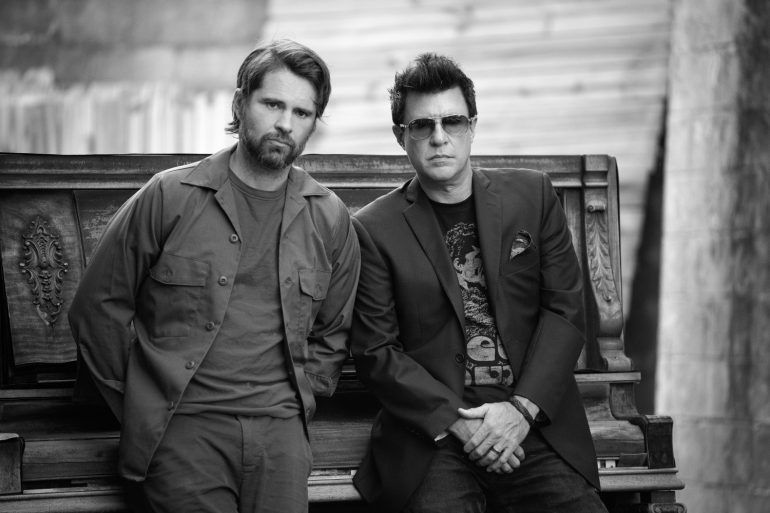
Bonneville, the Southern retro-soul outfit, is an inseparable musical duo. Jeff Hayashi and Wes McGee are the pair who have taken their modernised old-school sound to the studio. Along the way, they have shown a well-deserved respect to their inspirations, whilst branching off from their own unique artistic roots.
McGee, whose early memories include his father’s Gibson 335, has become a truly multi-faceted creative. His spark fires up beyond music to writing and acting. Hayashi shares a love for that particular Gibson model, buying an identical guitar for his own inspiration. With it, a foundational knowledge evolved into self-taught explorations.
Overall, Bonneville describes themselves as echoing the passions of the past, rather than rehashing the talents of the 70s. Hand-crafted, distinctly analogue and careful to leave in the ‘imperfections’ along the way.
That brings their story nicely to their new single. ‘In The Jungle’ was recently unveiled after the announcement of their third album, Hold for Room Tone. The scene is set, the decade is the 70s, and the location is inner-city Philadelphia. Hayashi says, “If a knife fight were a song, this is it.” So, it’s darker, tenacious, tough. Alongside that, it’s some of their most tightly groove-driven work to date, partly thanks to drummer Bernard Purdie’s work.
Bernard ‘Pretty’ Purdie is somewhat of a legend behind the kit, inducted into the 2013 Modern Drummer Hall of Fame, partly for his iconic Pudie Shuffle. Always able to play to their strengths, Bonneville has built the tune around this percussion master. From the opening, the drum groove is the central focus, joined by the bass movement and the tension in the strings and brass.
The band shares Bobby Womack and Donnie Hathaway as inspirations. I think there’s just as much of the Trouble Man soundtrack or Johnny Pate’s cinematic compositions. Still, when the vocals arrive, they’re as much aiming for infectious rhythm and blues as they are for silver-screen atmosphere. Climbing harmonies serve to uplift into impassioned multi-polar arrangements. The rise and fall continues, breaking back down to that instrumental soul and building to those climactic, ardent highs.
Over the four-minute runtime, there’s plenty of opportunity for each instrument to shine. A sleek guitar solo emerges in the back quarter, leading us out to the fade, the lack of immediacy in the ending carrying that groove well past the final moment.
The more we hear and see from Bonneville alongside Starita production and FAME Studios recordings, the more refined they seem to become.